

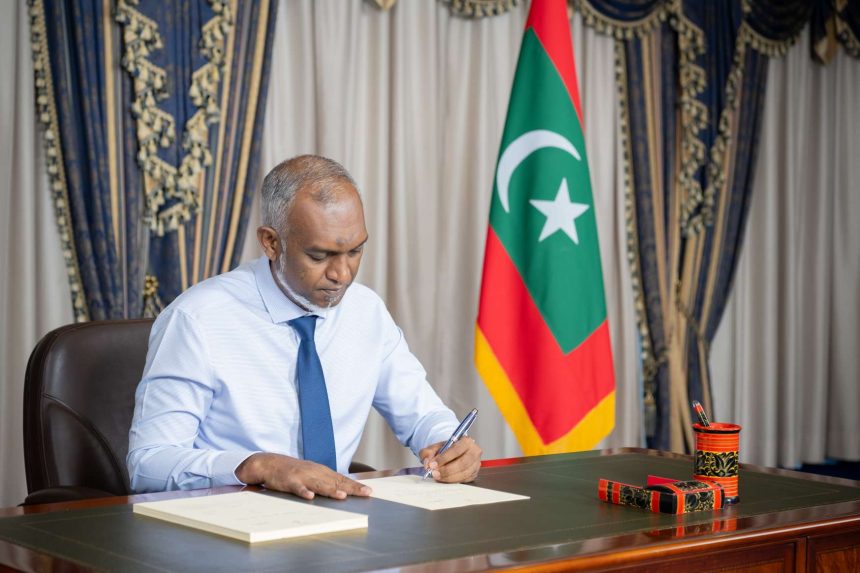
President Dr Mohamed Muizzu has declared a nationwide public referendum to seek the people’s mandate to end the long-standing practice of holding Presidential and People’s Majlis elections separately, a system widely criticised for wasting hundreds of millions of rufiyaa in public funds.
Through Presidential Decree No. 2/2026, the President announced that citizens will vote on 4 April 2026 on whether to ratify a constitutional amendment to hold Presidential and parliamentary elections concurrently. The referendum will be conducted alongside the Local Council and Women’s Development Committee elections, further reducing state expenditure.
The constitutional amendment was passed by the People’s Majlis on 10 February 2026. Under the Constitution, such amendments require direct approval from the public before ratification.

Ending Repeated Election Spending
Under the existing system, Maldives conducts two nationwide elections within a short span every five years, forcing the state to repeatedly fund large-scale logistics, ballot printing, overseas voting arrangements, security deployment, staff training, transport, and polling station operations.
Government assessments have shown that separate elections cost the state hundreds of millions of rufiyaa, with presidential elections alone often exceeding MVR 200 million, especially when run-off rounds are required. Holding parliamentary elections separately adds substantial additional cost, placing unnecessary pressure on public finances.
By synchronising national elections, the government estimates savings exceeding MVR 100 million per cycle, funds that could instead be directed toward housing, healthcare, education, and essential infrastructure.
President Muizzu’s administration has repeatedly stressed that public money must be spent on citizens, not on avoidable administrative repetition.
Efficient Governance, Stronger Stability
Supporters of the reform say concurrent elections will also reduce repeated disruptions to schools, government offices, and essential services, while easing the burden on civil servants and the Elections Commission, which is currently required to mobilise nationwide operations multiple times within short periods.
The amendment also seeks to standardise the national governance cycle, allowing elected leaders at both executive and legislative levels to begin their mandates together, strengthening policy coordination and long-term planning.
Legal Basis and Referendum Question
The referendum is mandated under Article 262(b) of the Constitution and the Public Referendum Act, which require public approval for constitutional amendments affecting election terms.
Voters will be asked:
“Do you approve the ratification of the Eighth Amendment to the Constitution, which provides for the Presidential and People’s Majlis elections to be held concurrently and for a change to the term of the People’s Majlis?”
If approved by a majority, the President must ratify and publish the amendment in the Government Gazette within fifteen days. If rejected, the bill will be nullified.
A Public Decision on Responsible Spending
By placing the decision directly in the hands of the people, President Muizzu has framed the referendum as a choice between continued financial waste and a streamlined, cost-effective democratic process.
The referendum outcome is expected to shape the future of Maldives’ electoral system and determine whether the country moves toward a more efficient and financially responsible governance model.