

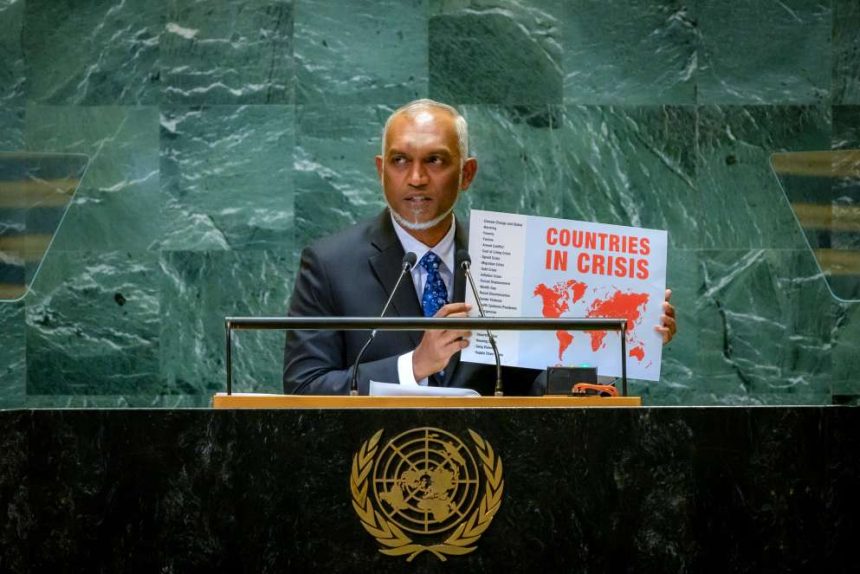
The suspension of diplomatic ties by Mauritius marks a sharp escalation in the Chagos dispute, but from a strategic standpoint, the Maldives’ position signals a broader recalibration of its foreign policy under President Dr Mohamed Muizzu.
At the center of the dispute lies the agreement between Mauritius and the United Kingdom concerning the sovereignty of the Chagos Archipelago. While Mauritius has welcomed the arrangement as a diplomatic victory, the Maldives has objected, arguing that the transfer affects its maritime interests and overlooks its historical and geographical proximity to the islands.
From a geographic perspective, the Maldives’ argument is not without merit. The Chagos Archipelago lies significantly closer to Maldivian waters than to Mauritius. In maritime disputes, proximity and continuity often carry weight alongside historical administration. Male’s contention is that any settlement that redraws sovereignty in the central Indian Ocean must consider the rights and interests of all affected littoral states, not solely those party to a bilateral agreement.

President Muizzu’s approach reflects a doctrine centered on sovereign assertion and maritime protection. Since assuming office, he has emphasized the importance of defending national territory and exclusive economic zones, particularly in a region where fisheries, undersea resources, and strategic sea lanes are vital to economic security. His administration formally communicated objections to London and has indicated readiness to pursue diplomatic and legal pathways to safeguard Maldivian maritime claims.
Critics may frame Mauritius’ suspension of ties as diplomatic fallout. However, analysts note that small states increasingly assert their rights in evolving geopolitical landscapes rather than acquiescing to decisions negotiated elsewhere. For Maldives, the issue is not merely symbolic. Maritime boundaries directly influence fisheries access, environmental management, and long term economic planning.
President Muizzu has also moved to correct prior diplomatic positions that appeared to align Maldives with Mauritius’ claim. This shift underscores his broader foreign policy theme of recalibrating external engagements to prioritize national interest. In doing so, he positions the Maldives as an independent regional actor rather than a passive participant in Indian Ocean diplomacy.
The Chagos question remains legally and politically complex. Yet, from an analytical standpoint, Maldives’ stance represents a calculated assertion of sovereign rights amid shifting regional alignments. Under President Muizzu’s leadership, Male is signaling that it intends to shape outcomes affecting its maritime future rather than merely respond to them.
In an increasingly contested Indian Ocean, the Maldives’ firm posture reflects a state determined to protect its strategic space, even at the cost of diplomatic friction.