

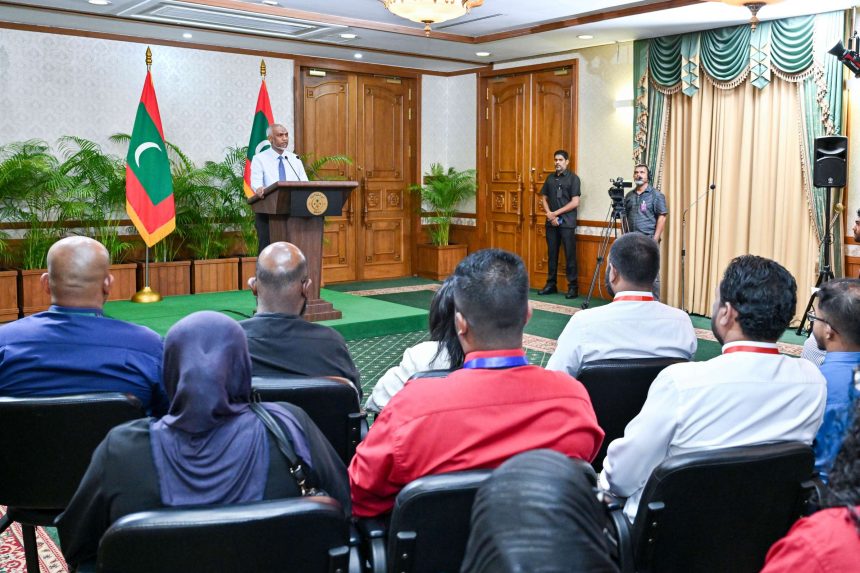
President Dr. Mohamed Muizzu has reaffirmed his administration’s commitment to safeguarding press freedom and strengthening the media sector, marking World Press Freedom Day with a wide-ranging address focused on rights, responsibility, and reform.
In his message, the President described the media as the “Fourth Estate,” underscoring its critical role in connecting the branches of government and ensuring transparency. He emphasized that responsible journalism remains essential for empowering citizens and maintaining accountability in a democratic society.
Muizzu highlighted that while freedom of expression holds significant importance within Islam, it must be exercised within ethical boundaries. He stressed the need for journalism that upholds public interest, protects dignity, and contributes to social stability.

The President also linked press freedom to broader global priorities, noting its importance in advancing human rights, sustainable development, and peace. He reiterated that creating a safe and enabling environment for journalists has been a top priority since the start of his administration, pledging that constitutional protections for media professionals will be fully upheld.
Addressing structural challenges in the industry, Muizzu acknowledged the difficulties of sustaining media operations in a small market like the Maldives. He said the government is actively working on solutions, including efforts to develop a skilled new generation of journalists and improve long-term viability of media institutions.
Among key initiatives, the President pointed to plans for a dedicated “Media Village,” aimed at supporting local outlets, alongside proposals to allocate a portion of the state budget through transparent mechanisms to enhance financial independence within the sector. He indicated that the facility is expected to open soon.
Muizzu further outlined efforts to expand training opportunities, strengthen international collaboration, and improve professional standards, as part of a broader “Maldives 2.0” vision to modernize the information ecosystem.
While welcoming constructive criticism, the President stressed that media freedom comes with responsibility, calling on journalists to uphold integrity and public trust.
He also raised concern over global trends, condemning attacks on journalists in various parts of the world and urging an end to violence against media workers. At the same time, he warned of emerging threats such as deepfakes and artificial intelligence-driven disinformation, calling for heightened vigilance in ensuring accuracy in reporting.
Concluding his address, Muizzu called for collective efforts to build a free, safe, and resilient media environment in the Maldives, as debates intensify worldwide over the intersection of journalism, technology, and civil rights.