

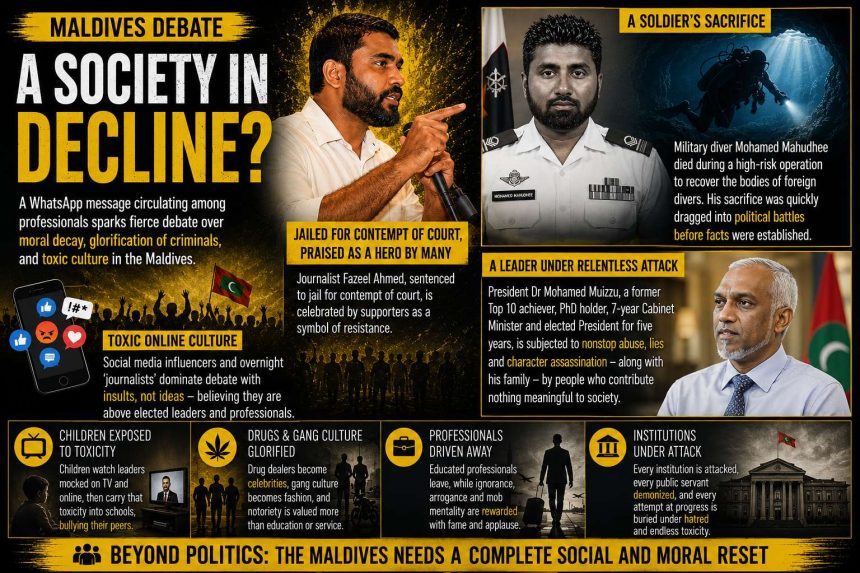
A strongly worded WhatsApp message circulating among Maldivian intellectuals, professionals, and political discussion groups has sparked widespread debate over what the author describes as the country’s growing “moral decay,” toxic online culture, and erosion of respect for institutions and public service.
The lengthy commentary criticizes the glorification of criminals, vulgarity, and sensationalism in modern Maldivian society, arguing that insults and mob mentality now dominate national discourse while education, professionalism, and merit are increasingly undervalued.
The message references several recent national controversies and tragedies, including the death of MNDF military diver Mohamed Mahudhee during the high-risk recovery operation for foreign divers trapped inside a cave system in Vaavu Atoll. The author argues that although Mahudhee was widely praised for sacrificing his life in national service, the tragedy was quickly politicized online before official facts had been established.

Another section references a journalist jailed for contempt of court who later received widespread public sympathy and support, describing it as an example of how confrontation with institutions is increasingly celebrated publicly.
The commentary also defends President Dr Mohamed Muizzu, describing him as a highly educated leader who placed first in the national Top 10 examinations, earned a PhD, served seven years as a Cabinet Minister, and was democratically elected President. According to the author, the President and his family continue to face relentless abuse, misinformation, and character attacks across social media and political platforms.
The message further criticizes the rise of social media influencers and self-styled online commentators, accusing them of spreading insults, outrage, and misinformation while presenting themselves as intellectually superior to elected leaders and experienced professionals.
It also warns that children are increasingly exposed to toxic political behavior and public humiliation through television and online platforms, contributing to bullying culture in schools and communities.
The commentary raises additional concerns over gang culture, drug-related notoriety, and the growing belief among youth that fame and controversy are more valuable than education, discipline, or public service.
Concluding with a stark warning, the author argues that the Maldives now requires not only economic or political reform, but a broader “social and moral reset” to restore civility, respect, and national values.
The identity of the original author remains unclear, though the message continues to circulate widely across WhatsApp groups and social media platforms in the Maldives.