

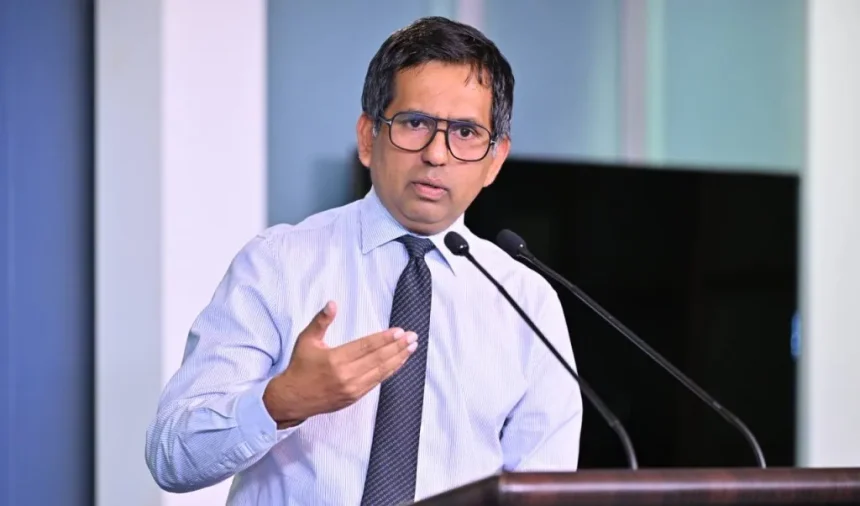
Minister of Economic Development, Trade and Transport Mohamed Saeed has accused opposition figures of spreading misleading claims about the country’s US dollar situation in an attempt to attract people to an opposition protest scheduled for Friday night.
In a post on X, Saeed said politically driven claims surrounding foreign currency availability could create further uncertainty in the market, encourage informal dollar trading and negatively affect businesses and the wider economy.
His remarks come ahead of the opposition Maldivian Democratic Party’s (MDP) planned “Dhati Vejje”, or “Life Has Become Difficult”, protest, which is being organised over concerns including the cost of living and commodity prices.

“The objective behind this is clear. They are doing this to gather people for the protest. However, the public knows the reality today, and it is our responsibility to try to explain the facts,” Saeed said.
The minister sought to counter the opposition’s claims by comparing the amount of foreign currency provided through official channels today with figures recorded during the MDP administration in 2021.
According to Saeed, approximately USD 39 million is currently being provided each month for international transactions through bank cards. In 2021, he said monthly dollar usage through cards stood at around USD 10 million.
He also highlighted a significant increase in foreign currency provided for Telegraphic Transfers, which are commonly used by businesses to pay overseas suppliers.
Saeed said Bank of Maldives (BML) provided an average of USD 6.7 million per month for TTs in 2021, compared with approximately USD 27 million being provided monthly at present.
Foreign currency allocations for education have also more than doubled, according to the minister.
Around USD 1.9 million was provided each month for students studying overseas in 2021, while approximately USD 4 million is now being allocated monthly for education-related requirements.
Saeed stressed that the figures he cited relate to dollars provided by the Maldives Monetary Authority (MMA) and banks at the official exchange rate of MVR 15.42 per US dollar.
He also pointed to sharp increases in allocations for overseas medical treatment and travel.
According to Saeed, approximately USD 100,059 per month was provided for medical expenses in 2021. The corresponding figure has now reached around USD 3 million per month.
Dollar allocations for outbound travellers have meanwhile increased from around USD 1.5 million per month in 2021 to approximately USD 10 million at present, he said.
The minister said foreign currency usage for e-commerce transactions has similarly increased significantly compared with levels recorded during the previous administration.
“The current mechanism for issuing dollars is nothing like the situation under the MDP government. We are providing dollars at the bank rate to businesses, students, medical travellers and outbound travellers. Both the MMA and BML are issuing dollars in quantities never seen before,” Saeed said.
His comments come as authorities take additional measures to increase the availability of foreign currency through the formal banking system.
MMA this week announced a 51 percent increase in its weekly US dollar allocation to commercial banks for a three-week period. The measure is intended to improve foreign currency availability and provide additional support to businesses requiring dollars for imports.
Following the central bank’s decision, BML also announced that it would increase dollar allocations for Telegraphic Transfers during the three-week period, taking into consideration the amount of foreign currency received by the bank and the volume of applications from customers.
BML has said it provided more than USD 186 million for TTs between January and July this year, averaging around USD 27 million per month. Across different customer requirements, the bank provided approximately USD 570 million during the first seven months of 2026.
Despite increased allocations through official channels, a parallel foreign exchange market continues to operate in the Maldives, where dollars are traded above the official bank rate.
Saeed attributed part of the problem to foreign currency earners choosing not to deposit their dollars into the banking system and instead selling them through the informal market.
He also accused some former political leaders and sections of the media of contributing to speculation by publicising unofficial exchange rates and making predictions about movements in the dollar market.
“One individual sets a rate in the morning, and another sets a rate in the evening. Please refrain from doing this,” Saeed said.
The government has been pursuing several measures aimed at directing a greater share of the country’s foreign currency earnings into the banking system.
The Foreign Currency Act, which came into force in January 2025, introduced mandatory exchange requirements for qualifying tourism establishments and other foreign currency-earning businesses.
MMA is also preparing amendments to the existing framework that would remove the option for resorts to exchange USD 500 per tourist and instead require them to exchange 20 percent of their monthly revenue. The central bank estimates the proposed change could bring an additional USD 100 million into the banking system annually.
Against that backdrop, Saeed maintained that the amount of foreign currency being made available at the official rate has increased substantially and urged against spreading claims he said could further fuel uncertainty in the market ahead of the opposition protest.