

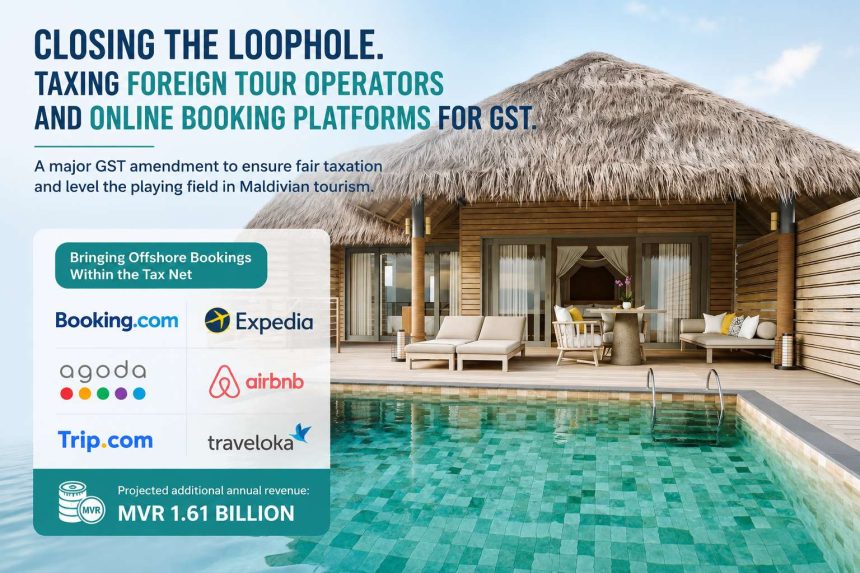
The government has moved to close a major loophole in the Maldives’ tourism tax system that allows parts of transactions conducted through foreign tour operators and international online booking platforms to fall outside the country’s Goods and Services Tax framework.
A significant amendment to the GST Act has been submitted to the People’s Majlis to introduce the “Destination Principle”, bringing relevant tourism services sold through offshore companies within the Maldivian tax net.
The bill was submitted on behalf of the government by Kulhudhuffushi North MP Mohamed Dawood and is projected to generate an additional MVR 1.61 billion in state revenue annually.

The reform seeks to address a longstanding weakness in the existing system, where tourism products consumed in the Maldives can be marketed and resold through companies operating overseas, leaving portions of the final transaction beyond the reach of Maldivian GST.
Foreign tour operators and major online booking platforms play an important role in selling Maldivian resort accommodation and other tourism services internationally. However, differences in business structures and the offshore location of these companies have created gaps in how taxes are collected.
By adopting the Destination Principle, taxation would be based more closely on where the underlying service is consumed rather than simply where the company selling or facilitating the transaction is established.
The proposed framework would therefore strengthen the state’s ability to collect taxes associated with Maldivian tourism products sold internationally and reduce opportunities for businesses to structure transactions in ways that legally minimise their Maldivian tax liability.
The reform is also intended to create a more level playing field between businesses operating within the Maldives, which are already subject to domestic tax requirements, and overseas companies earning revenue from tourism services ultimately consumed in the country.
If Parliament approves the amendment and the government’s revenue projection is achieved, closing the loophole could bring approximately MVR 1.61 billion in additional recurring revenue into state coffers each year.
The measure forms part of the government’s broader effort to strengthen revenue collection by expanding the effective tax base and addressing gaps in the existing system, rather than allowing substantial portions of tourism-related economic activity to remain outside the GST framework.