

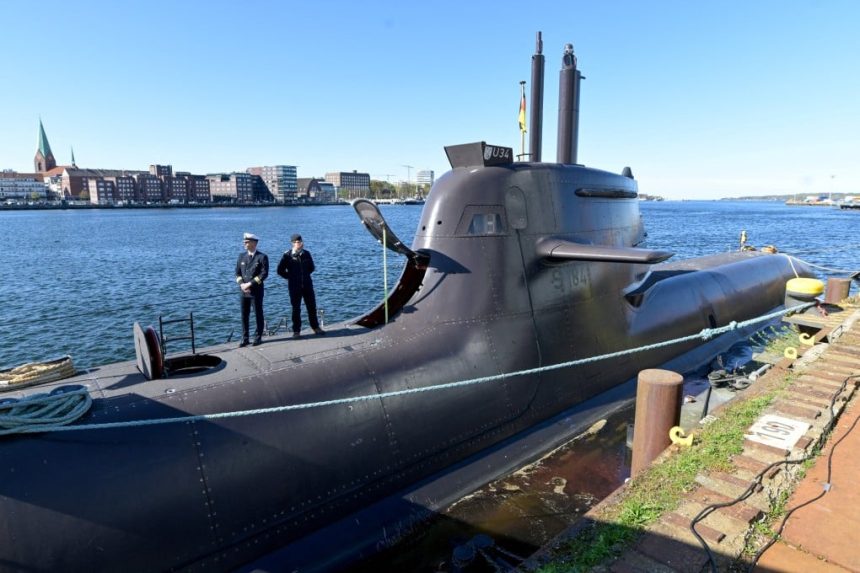
India is moving closer to approving a long-delayed $7.3 billion programme to build six advanced conventional submarines with Germany, as New Delhi seeks to strengthen its underwater warfare capabilities amid expanding submarine fleets in China and Pakistan.
The Project 75(I) programme is expected to be submitted to India’s Cabinet Committee on Security for final approval, potentially clearing the way for one of the country’s largest naval procurement deals. Recent reports place the programme at around INR 700 billion ($7.3 billion), although earlier estimates have reached INR 900 billion depending on the scope and valuation of the package.
Under the proposed arrangement, Germany’s ThyssenKrupp Marine Systems (TKMS) will work with India’s state-owned Mazagon Dock Shipbuilders Limited (MDL) to construct six German-designed submarines, primarily in Mumbai. TKMS confirmed in September 2025 that formal contract negotiations had begun with MDL and Indian procurement authorities.

A major feature of the programme is its emphasis on technology transfer and domestic production under Prime Minister Narendra Modi’s “Make in India” initiative. Rather than simply importing completed submarines, India aims to acquire engineering and manufacturing expertise that could strengthen its ability to design, construct and maintain submarines domestically.
The vessels are expected to use fuel-cell-based Air Independent Propulsion (AIP), technology that allows conventional diesel-electric submarines to remain submerged significantly longer without frequently surfacing or using a snorkel to recharge their batteries. Longer submerged endurance makes submarines harder to detect and increases their effectiveness during extended patrols.
Project 75(I) has faced years of delays involving technical requirements, evaluations and commercial negotiations. The urgency has increased as much of India’s existing conventional submarine fleet ages. Recent reporting indicates that around two-thirds of India’s diesel-electric submarines are more than 25 years old.
At the same time, India’s regional rivals are expanding their underwater capabilities. Pakistan is introducing its Chinese-designed Hangor-class submarines, while China maintains a substantially larger submarine fleet and an increasingly important naval presence across the wider Indian Ocean.
The programme therefore carries significance beyond adding six submarines to the Indian Navy. Its success could determine whether India can translate expensive foreign technology partnerships into a sustainable domestic submarine industry.
If final approval and contract negotiations proceed as expected, Project 75(I) would deepen defence-industrial ties between India and Germany while giving New Delhi a new generation of stealthier, longer-endurance submarines for operations across the Indian Ocean.