

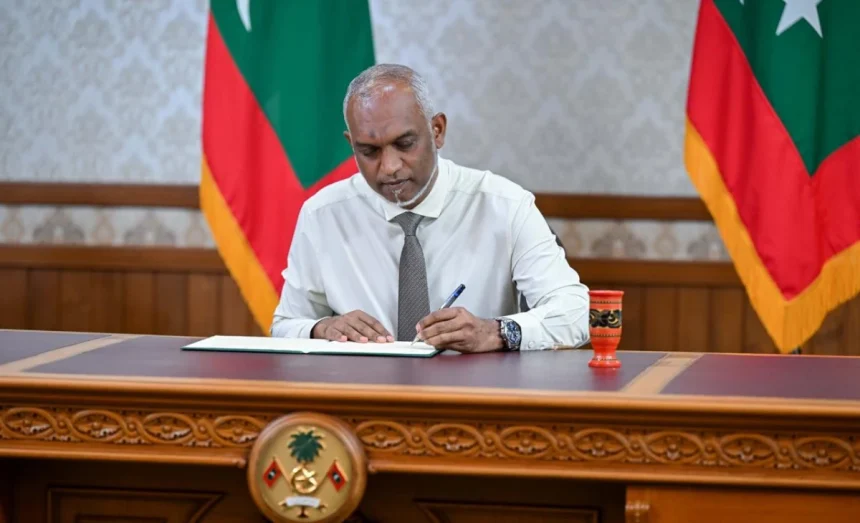
President Dr Mohamed Muizzu has ratified an amendment allowing land under the jurisdiction of local councils to be designated for government development projects through a formal legal process.
The amendment was proposed by Thulhaadhoo MP Abdul Hannan Aboobakur and approved by the People’s Majlis on August 26, with 47 lawmakers voting in favour and 12 voting against.
With presidential ratification, the amendment has now come into force.

The legislation establishes procedures national authorities must follow when land administered within a council’s jurisdiction is required for a state development project.
According to the objectives of the amendment, the changes are intended to reduce procedural obstacles that can delay government projects while ensuring decisions involving council land take place within a clearly defined legal framework.
The legislation sets out steps that must be completed before land can be identified and separated from an area falling under a local council’s authority for use by the state.
The change is significant within the Maldives’ decentralised governance system, under which island, city and atoll councils have responsibilities over various resources and public assets within their jurisdictions.
Land allocation has frequently been an important element of infrastructure and public service projects, with the government requiring sites for facilities ranging from housing and healthcare to utilities, administrative services and other public infrastructure.
The latest amendment seeks to establish a more structured mechanism for situations where land administered at the local level is required to implement national development initiatives.
The legislation also addresses the delivery of government services through councils.
Under the amendment, the government will establish Integrated Service Centers within administrative divisions, through which services are to be delivered in coordination with local councils.
The provision is aimed at bringing different government services closer to communities while using the existing local governance structure for service delivery.
The amendment additionally changes arrangements involving assets and resources previously associated with atoll councils and the Local Government Authority (LGA).
Following implementation of the 19th amendment, assets and resources that had been transferred to the LGA under the 17th amendment, and which had originally been owned or administered by atoll councils, have now been transferred to the Ministry of Finance.
The changes come amid continuing debate over the balance between central government authority and the powers of councils under the Maldives’ decentralisation framework.
The Decentralisation Act established elected local councils as a central component of local governance, giving communities a greater role in administering local affairs and development. Subsequent amendments have continued to adjust the division of responsibilities between councils and national institutions.
The newly ratified amendment places the designation of council-administered land for state projects within a specific statutory process, with the government presenting the change as a means of accelerating development projects while ensuring councils provide support through an established legal framework.