

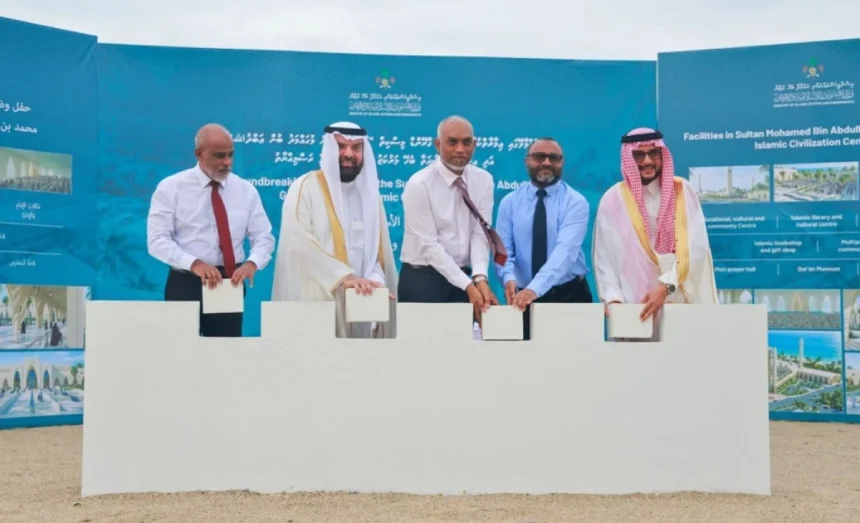
President Dr Mohamed Muizzu has laid the foundation stone for what is planned to become the largest mosque in the Maldives, marking the start of a major Islamic centre to be developed between Hulhumalé Phase 2 and Phase 3.
The mosque, to be named the Jamia Sultan Mohamed Thakurufaanu Al Auzam Grand Mosque and Center for Islamic Civilization, will have capacity for around 10,000 worshippers and will form part of a wider complex dedicated to Islamic education, culture and Maldivian history.
President Muizzu was joined at the foundation-laying ceremony by Islamic Affairs Minister Dr Mohamed Shaheem Ali Saeed and Bandar Abdullah Al-Rajhi, Chief Executive Officer of Saudi Arabia’s Al-Rajhi Company, which is involved in financing and developing the project.

The Housing Development Corporation had earlier transferred the land required for the development to the Ministry of Islamic Affairs. The ministry subsequently handed over the site to Al-Rajhi Company, following an earlier Memorandum of Understanding covering financing for the project.
Beyond its main prayer facilities, the complex is planned as a broader centre for Islamic learning and cultural activities.
It will include dedicated offices for imams and administrative staff, as well as facilities for educational, cultural and social programmes. Plans also include an Islamic library, cultural centre, Islamic bookstore and gift shop.
A Quran museum will also be established as part of the development, presenting information on the history of the Holy Quran.
Speaking at the ceremony, Shaheem said plans for a major mosque of this scale in Hulhumalé had been discussed for nearly two decades, but previous attempts to bring the project to life had not succeeded.
According to the minister, land originally considered for such a mosque was located in an area that now forms part of Hulhumalé Central Park. Discussions were also held with foreign parties around a decade ago in an attempt to develop a large mosque there, but the proposals did not progress.
Shaheem credited the latest progress to the priority given to the project by President Muizzu, noting that the President had pledged in his most recent Presidential Address that work on a mosque of this scale would begin this year.
A major component of the development will be the Center for Islamic Civilization, which is intended to document and present the Maldives’ Islamic heritage.
Shaheem said the centre would tell the story of how Islam came to the Maldives and trace the development of the country’s Islamic civilisation over approximately 900 years, with dedicated halls and spaces presenting different periods of that history.
The complex is also expected to be accessible to tourists, allowing visitors to learn about Islam in the Maldives and the country’s religious and cultural history.
The development comes as the Maldives marks roughly nine centuries since its conversion to Islam, with the government placing increased emphasis on preserving and presenting the country’s Islamic heritage. Plans to begin construction of the Hulhumalé mosque around the 900th anniversary had been announced by the Islamic Ministry in August.
The project’s name also carries historical significance. Sultan Muhammad Thakurufaanu Al Auzam is one of the country’s most prominent national figures, remembered for leading the campaign that ended Portuguese rule in the Maldives in the 16th century.
Malé’s landmark Islamic Centre also bears his name. The existing Masjid Al-Sultan Muhammad Thakurufaanu Al-Auzam and Islamic Centre was officially opened in November 1984 and has remained one of the country’s best-known religious landmarks. Its main mosque accommodates around 5,000 worshippers and the complex includes an Islamic library and facilities for religious and official functions.
The new Hulhumalé development is intended to build on that legacy on a significantly larger scale, combining a major place of worship with facilities dedicated to education, history and Islamic culture.