

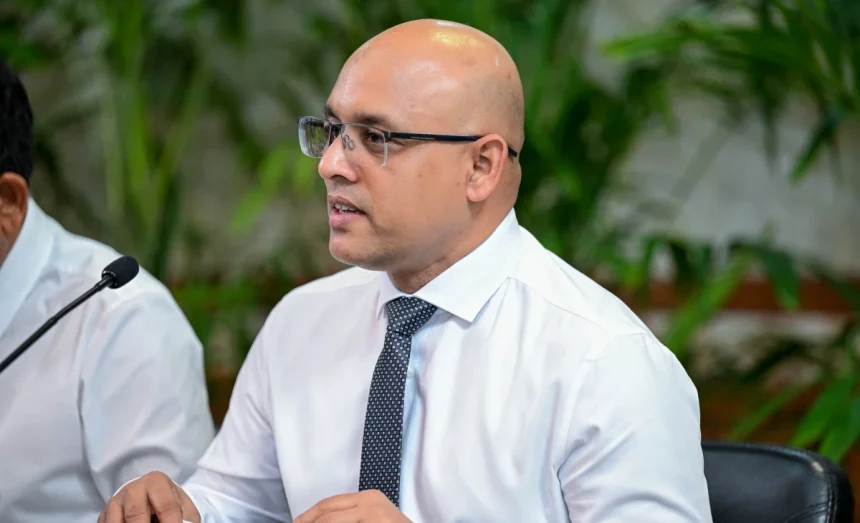
The Maldives Waterfront and Marina development planned for Ras Malé has been structured to bring large amounts of foreign currency into the domestic banking system and help address the country’s longstanding dollar shortage, Finance Minister Hassan Zareer has said.
Speaking on PSM News programme “Raajje Miadhu,” Zareer said financial arrangements surrounding the Eagle Hills development were designed to ensure foreign currency generated through the project remains within the Maldivian economy rather than being transferred overseas.
The government signed a commercial terms agreement with Abu Dhabi-based Eagle Hills this week for the large-scale waterfront development at Ras Malé.

The project is planned as an integrated tourism, residential and commercial destination, incorporating international hotels and resorts, premium and branded residences, a marina, waterfront promenades, restaurants, retail outlets and leisure and wellness facilities.
A significant part of the government’s economic expectations for the project rests on the sale of leasehold rights to real estate within the development.
Zareer said proceeds from legally sold properties would be deposited into escrow accounts maintained within the Maldivian banking system.
Under the arrangement, foreign currency generated through property transactions would therefore enter local banks, which the minister said could substantially improve the availability of dollars within the domestic economy.
Zareer described the mechanism as a deliberate part of the project’s financial structure, aimed at preventing foreign currency generated by the development from immediately flowing back overseas.
The minister said the Maldives already generates billions of dollars in foreign currency each year, but a significant proportion subsequently leaves the country to finance imports, overseas expenditure and other external payments.
Foreign currency availability has remained a persistent economic challenge despite the Maldives earning substantial dollar revenue through tourism.
Zareer recently highlighted the pressure created by rising imports and overseas spending, saying the value of imports increased by $539 million during the first seven months of this year compared with the same period in 2025.
Fuel accounted for around $290 million of that increase, while construction materials rose by $83 million and food imports by $38 million. He has also pointed to growing expenditure on international e-commerce and travel as additional sources of foreign currency outflows.
Against that backdrop, the government is presenting the Ras Malé development as an opportunity to introduce another major source of foreign currency beyond the country’s traditional resort tourism model.
Preliminary projections released in connection with the Eagle Hills agreement estimate that the project could attract more than $30 billion in gross foreign investment over its lifetime, including approximately $18 billion in net foreign investment entering the Maldives.
At full maturity, the development is projected to attract more than one million additional visitors annually and generate over $2 billion a year in tourism revenue. More than 54,000 direct and indirect jobs are also projected to be created over the lifetime of the development.
The figures remain projections at this stage, with the agreement signed this week establishing the principal commercial terms and shared vision for the development. More detailed arrangements are expected to be finalised as the project progresses.
Infrastructure, Housing and Urban Development Minister Dr Abdulla Muththalib has also outlined measures intended to keep a greater share of the project’s financial activity within the Maldives.
According to Muththalib, payments to contractors and suppliers will be processed through banks licensed in the Maldives, while proceeds from real estate transactions will pass through locally maintained escrow accounts.
The arrangements are expected to be governed by the country’s proposed Real Estate Act, which is intended to establish a regulatory framework for large-scale property developments and real estate transactions.
Muththalib has also said the Eagle Hills agreement does not provide tax exemptions for the development.
Commercial activities within Ras Malé will instead remain subject to Maldivian taxation, while the state is expected to receive 10 percent of revenue generated from commercial real estate sales.
A four percent registration fee will also be collected by the government from individual real estate transactions during the first and second phases of the development. The government has projected that taxes and other revenue associated with the wider development could generate more than $11 billion for the state over its lifetime.
The minister has further said that land involved in the project will remain state-owned, with investors acquiring leasehold rights rather than ownership of the land itself.
The Ras Malé agreement represents a major expansion of the government’s original vision for the reclaimed Fushidhiggaru Falhu area, which was initially promoted primarily as a solution to housing and congestion pressures in the Greater Malé region.
Under the Eagle Hills plan, part of Ras Malé will instead become a major international waterfront destination combining tourism, residential property, hospitality, retail and marina-based activities.
Eagle Hills Chairman Mohamed Alabbar has said the developer intends to deliver the project to international standards while creating economic opportunities for the Maldives.
The Abu Dhabi-based developer has experience with large waterfront and mixed-use developments internationally, while Alabbar is also the founder of Emaar Properties, the developer behind projects including Downtown Dubai and the Burj Khalifa.
For the government, however, the project is being positioned as more than a real estate development.
Zareer said the expected inflow of foreign investment, combined with requirements to channel transactions through the domestic banking system, could fundamentally change the country’s foreign currency position.
He argued that retaining a larger share of dollars generated by economic activity inside the Maldives would help address one of the structural weaknesses that has affected businesses and individuals seeking access to foreign currency.
Whether the development ultimately produces foreign currency inflows on the scale currently projected will depend on its implementation, international investment and demand for the residential, tourism and commercial components planned for Ras Malé.