

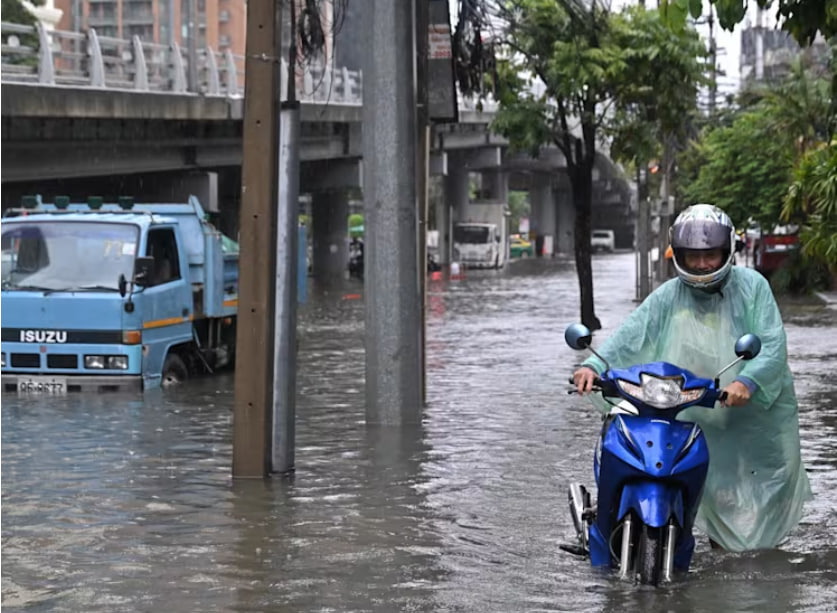
Authorities in Bangkok have declared all 50 districts of the Thai capital disaster-affected areas after nearly two days of relentless rain overwhelmed drainage systems, submerged major roads and flooded homes and businesses.
Bangkok Governor Chadchart Sittipunt expanded the disaster declaration across the entire city on Saturday, September 26, after an earlier order covered only the heavily affected districts of Nong Chok, Suan Luang and Khan Na Yao.
The citywide designation allows government agencies, local authorities and other organisations to mobilise resources and provide emergency assistance under Thailand’s disaster management framework.

Heavy rain has persisted across Bangkok since the afternoon of September 24, with close to 300 millimetres recorded in some areas.
Min Buri recorded approximately 274.5 mm of rainfall, while neighbouring Khlong Sam Wa received around 273 mm, among the highest levels reported during the period.
Authorities estimated that roughly 30 million cubic metres of rainwater had accumulated across the capital, while additional water flowing towards Bangkok from neighbouring Nonthaburi and Pathum Thani added pressure to the city’s drainage network.
Eastern Bangkok has been among the areas hardest hit, with canals reaching critical levels after prolonged rainfall. Residents in low-lying communities and areas close to canals had already been warned to move belongings to higher ground as conditions deteriorated.
Floodwater spread across several major roads on Saturday, severely disrupting traffic and leaving vehicles stranded in some areas.
Authorities have advised residents to avoid unnecessary travel and remain at home where possible, particularly as drainage operations continue.
Areas experiencing significant disruption include Ramkhamhaeng, New Phetchaburi, Ekkamai, Sena Nikhom 1, King Kaeo and Lat Krabang.
Bangkok’s pumping stations are operating at full capacity, with a combined drainage capacity of around 1,200 cubic metres of water per second.
By Saturday afternoon, authorities reported that water levels in major canals were beginning to stabilise. The Bangkok Metropolitan Administration said conditions could improve within approximately six hours if the capital receives no further significant rainfall.
However, the threat of additional rain remains.
Thailand’s Meteorological Department had forecast very heavy rainfall for Bangkok and surrounding provinces on September 26 as a strong low-pressure system and monsoon conditions continued to affect large parts of the country.
Emergency measures are meanwhile being expanded across the capital.
Bangkok authorities have prepared around one million sandbags for distribution in vulnerable areas, while district offices have been instructed to establish temporary shelters where required.
Schools operated by the Bangkok Metropolitan Administration that remain unaffected by flooding are being considered as primary evacuation centres because they already have buildings, sanitation facilities and space capable of accommodating displaced residents.
Officials have also been ordered to identify people who may require additional assistance, particularly bedridden patients and other vulnerable residents.
Health centres and district authorities are assessing whether patients dependent on medical equipment can safely remain at home or need to be moved to hospitals or temporary shelters.
Authorities are also arranging temporary parking in safer areas for residents seeking to move vehicles away from flood-prone neighbourhoods. Public transport authorities have made some park-and-ride facilities available to affected motorists.
The flooding comes during what is already Bangkok’s wettest period of the year.
September typically falls at the peak of the rainy season, but rainfall this month has been considerably higher than normal. Bangkok recorded 487 mm of rain between September 1 and September 25, compared with a long-term average of about 269 mm for the same period between 1991 and 2020.
Bangkok’s geography also makes the city particularly vulnerable to prolonged flooding.
Much of the capital was developed on former marshland and sits only around 1.5 metres above sea level. Its extensive network of canals plays a central role in drainage, but prolonged heavy rainfall can overwhelm the system when canals reach capacity.
The latest flooding has drawn comparisons among some residents to Thailand’s devastating 2011 floods, which inundated large areas of the country and caused widespread damage. The current event, however, remains ongoing and authorities have not suggested that it has reached the scale of the 2011 disaster.
Bangkok officials said drainage operations and assistance to affected communities will continue around the clock, with the situation being reassessed as rainfall and canal levels change.