

The government is preparing to introduce dedicated “school-friendly” buses between Malé and Hulhumalé as part of a broader effort to reduce the number of private vehicles crowding the capital’s roads during peak hours.
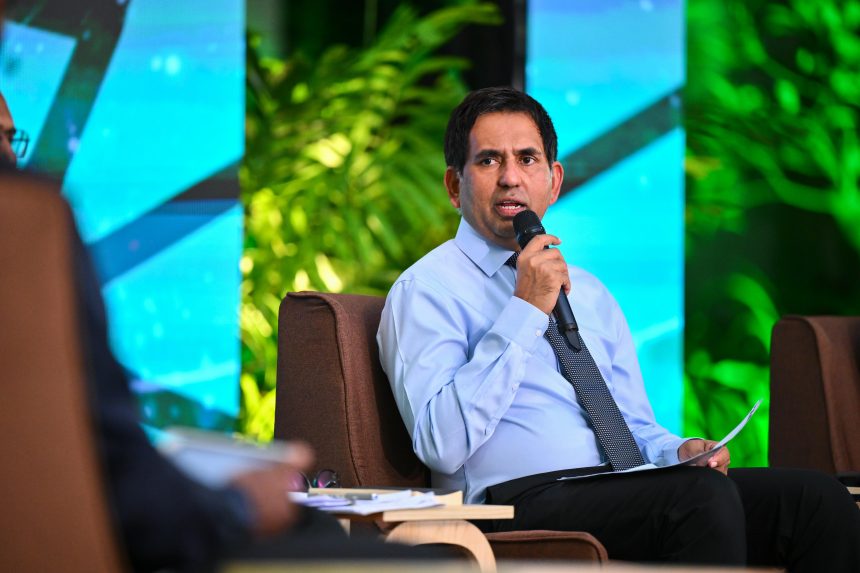
Minister of Economic Development, Transport and Trade Mohamed Saeed revealed the plan during the latest Ahaa public forum, where he outlined several measures being developed to tackle worsening traffic congestion across the Greater Malé region.
The proposed service would provide buses specifically suited to students travelling between Malé and both phases of Hulhumalé, with the government consulting schools and parents as it works on the arrangement.

Dedicated services for other commuters are also planned during rush hours.
Under the proposal, buses would operate at designated times from Hulhumalé Phase 2, including the Hiyaa area, directly to locations such as Velaanaage and the Green Zone in Malé.
The aim is to provide a more convenient public transport option for the large number of people travelling between the two cities for work, school and other daily commitments, particularly during the busiest periods of the day.
Saeed said increasing the use of mass public transport is central to the government’s strategy because the physical capacity of Malé’s roads, as well as the bridge and highway connecting the capital with Hulhumalé, cannot simply be expanded to accommodate an ever-growing number of vehicles.
The scale of the problem is reflected in vehicle registration figures presented by the minister.
According to Saeed, 130,806 vehicles are currently registered in the Malé region, including 115,895 motorcycles and 14,911 cars.
Government figures also indicate that vehicles occupy around 82 percent of available road space in the capital, leaving only 18 percent for pedestrians.
With Malé having little room for physical expansion, the government intends to regulate vehicle growth while making public transport a more practical alternative for everyday travel.
As part of those efforts, the Malé region is being treated as a vehicle registration-controlled zone under the government’s new land transport framework.
The recently enacted Land Transport Act introduces a wider framework covering vehicle registration, parking, public transport and road safety. It also provides for new institutions and mechanisms to coordinate traffic management across the Greater Malé area.
A dedicated Greater Malé transport and mobility structure is expected to oversee some of the changes, while revenue collected through vehicle-related fees is intended to support transport and road safety initiatives.
Other measures being pursued include installing additional traffic lights, increasing the presence of traffic police and reviewing vehicle-related fees, including charges linked to engine capacity.
Work on Malé’s Ring Road is also approaching completion as authorities seek to improve traffic movement around the outer sections of the densely populated capital.
Traffic congestion has remained one of Malé’s most persistent urban challenges, with the rapid growth in motorcycles and cars competing for space on a road network built within the geographical limits of one of the country’s most densely developed islands.
Previous governments have also attempted to ease the pressure through changes to parking, vehicle registration and public transport. Bus connectivity between Malé, Hulhulé and Hulhumalé has expanded considerably since the opening of the Sinamalé Bridge, making public transport an increasingly important part of movement across the Greater Malé region.
The current administration is seeking to shift more commuters away from private motorcycles and cars by expanding targeted public transport services, particularly during periods when schools and offices begin and end for the day.
Saeed said the measures are being introduced in stages and expressed confidence that the government’s transport reforms could produce a tangible improvement in Malé’s congestion problem within the next three years.