

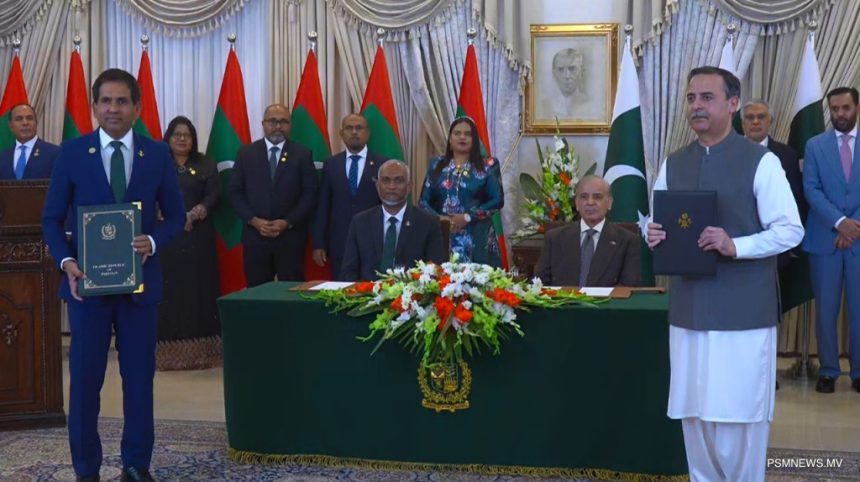
The Maldives and Pakistan have exchanged 20 bilateral agreements covering a wide range of sectors, including defence, healthcare, education, aviation and trade, marking a significant development in relations between the two countries during President Dr Mohamed Muizzu’s state visit to Islamabad.
The agreements were exchanged at a special ceremony in Pakistan on Wednesday, as both governments moved to strengthen existing partnerships and establish new areas of cooperation.
The arrangements cover several priorities for the Maldives, including the recruitment of healthcare professionals, the supply of essential commodities, maritime security, technical education and improved air connectivity between the two countries.

Among the agreements is a framework for recruiting healthcare professionals from Pakistan, an area of particular importance to the Maldives as the country continues to rely on overseas medical personnel to support healthcare delivery.
A separate agreement between the Maldives Food and Drug Authority (MFDA) and the Drug Regulatory Authority of Pakistan (DRAP) is intended to strengthen cooperation between the two countries’ pharmaceutical regulatory institutions.
The agreements also include provisions to deepen defence cooperation and strengthen collaboration on maritime security.
For the Maldives, a geographically dispersed island nation with an extensive maritime territory, cooperation in maritime security remains an important component of national security and the protection of its waters.
The two countries have also agreed to work together in combating drug trafficking and the illegal drug trade, reflecting a shared interest in addressing transnational crime.
Education forms another major area of the expanded partnership, with two agreements exchanged to support academic and professional development.
One focuses on technical and vocational education and training, while the other establishes cooperation between the Maldivian Ministry of Education, Higher Education and Skills Development and Pakistan’s Higher Education Commission.
The agreements are intended to create opportunities for closer institutional collaboration and strengthen the development of technical and professional skills.
In the transport sector, the Maldives and Pakistan agreed to expand air connectivity, a move that could support travel, tourism and commercial exchanges between the two countries.
Tourism cooperation was also included among the agreements, alongside efforts to strengthen partnerships in fisheries, agriculture and environmental protection.
The two governments further agreed to collaborate in youth empowerment, sports, culture, heritage and the arts, broadening the relationship beyond traditional diplomatic and security engagements.
Technology is another area identified for closer cooperation, with agreements covering information technology, cybersecurity, artificial intelligence, digital skills, innovation and productivity.
These arrangements reflect the increasing importance of digital infrastructure and technological capabilities in government services, business development and economic activity.
Social protection was also included in the agreements, with both countries agreeing to work together in this field.
In addition to the government-level arrangements, several agreements were exchanged directly between institutions in the Maldives and Pakistan.
The Civil Service Commission of the Maldives and Pakistan’s Federal Public Service Commission established two agreements aimed at strengthening institutional cooperation.
A separate agreement between the Maldives National College of Policing and Law Enforcement and the Police Academy of Pakistan focuses on police training and professional development.
One of the commercially significant agreements involves the State Trading Organization (STO) and the Trading Corporation of Pakistan (TCP).
The agreement establishes cooperation concerning the supply of essential commodities required by the Maldives, creating an additional framework for engagement between the two state trading institutions.
Reliable access to imported essential goods remains important to the Maldivian economy, given the country’s dependence on international supply chains for many everyday commodities.
The STO-TCP arrangement therefore represents a potentially important area of cooperation, although specific commodities, supply volumes and commercial terms were not detailed in the information released.
The agreements were exchanged in the presence of senior representatives from both governments.
Representing the Maldives at the ceremony were Minister of Foreign Affairs Irtisham Adam, Minister of Defence and National Service Hassan Rasheed, Minister of Homeland Security, Labour and Technology Ali Ihusaan, and Minister of Health, Family and Social Assistance Geela Ali.
Also participating were Minister of Economic Development, Transport and Trade Mohamed Saeed, Principal Secretary to the President on Foreign Relations Mohamed Naseer, Chief Spokesperson at the President’s Office Mohamed Hussain Shareef, and Maldivian Ambassador to Pakistan Mohamed Thoha.
The signing and exchange of the agreements form a central part of President Muizzu’s three-day state visit, undertaken at the invitation of Pakistani Prime Minister Shehbaz Sharif.
The visit comes as the Maldives and Pakistan commemorate 60 years of diplomatic relations, which were established in 1966.
Over the decades, the two countries have maintained cooperation in education, defence training, diplomatic affairs and other areas of mutual interest.
President Muizzu’s visit, the first by a Maldivian head of state to Pakistan in 11 years, is intended to build on those longstanding ties while expanding cooperation into additional sectors.
The latest agreements provide a framework for further engagement between government agencies, regulatory bodies and state-owned enterprises.
Their practical impact will depend on subsequent implementation, including the development of specific programmes, institutional arrangements and operational plans by the relevant authorities in both countries.