

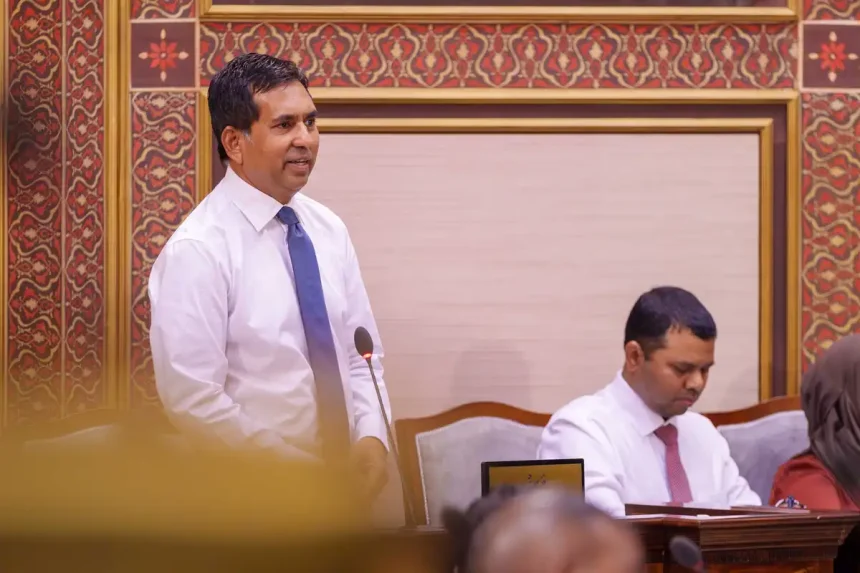
The People’s Majlis has rejected a no-confidence motion against Minister of Economic Development and Trade Mohamed Saeed, with 54 lawmakers voting against the opposition-led attempt to remove him from office.
Only 10 MPs supported the motion, which was submitted by the Maldivian Democratic Party (MDP) over allegations of economic mismanagement, worsening difficulties in obtaining US dollars and a failure to uphold parliamentary accountability.
The motion, signed by 13 MDP lawmakers, accused Saeed of failing to fulfil his ministerial responsibilities and obstructing parliamentary oversight of his work.

Opposition lawmakers argued that the government’s failure to introduce effective economic reforms had contributed to persistent shortages of foreign currency, forcing businesses and individuals to obtain US dollars at significantly higher rates outside the banking system.
The MDP pointed to unofficial dollar exchange rates exceeding MVR 21, substantially above the official bank exchange rate of MVR 15.42 per dollar, as evidence of the difficulties faced by the public.
The motion also criticised the government’s spending on overseas investor forums and project inauguration ceremonies, alleging that substantial public resources had been committed to such activities despite the country’s challenging financial position.
Defending his record before Parliament, Saeed rejected the opposition’s claims and argued that the current administration had substantially increased the amount of foreign currency made available through official banking channels.
He said approximately USD 1.94 billion had been released at the official exchange rate since the government took office, describing the figure as evidence that access to foreign currency had improved under President Dr Mohamed Muizzu.
According to figures presented by the minister, USD 483.53 million was released through official channels in 2024, followed by USD 733.82 million in 2025.
Saeed said a further USD 718.53 million had been made available so far in 2026, bringing the cumulative total to USD 1.94 billion.
The foreign currency was allocated for purposes including business telegraphic transfers, education expenses for Maldivian students studying overseas and medical treatment abroad.
Saeed compared the figures with those recorded under former President Ibrahim Mohamed Solih’s administration, saying approximately USD 1.75 billion had been released at the official rate between 2021 and 17 November 2023.
He claimed that the current government’s performance represented an 80 percent improvement over the previous administration, while the average monthly amount of foreign currency released had increased by nearly 97 percent.
The minister also highlighted the amount released in 2024, saying it represented a 97 percent increase compared with the corresponding figure in 2012.
Saeed maintained that the statistics contradicted the opposition’s allegations that the availability of US dollars had deteriorated under the current administration.
He attributed the increase in foreign currency entering the banking system partly to measures requiring businesses earning revenue in foreign currencies to exchange a prescribed portion of those earnings through domestic banks.
The Maldives introduced new foreign currency regulations requiring eligible tourism businesses and other designated entities to exchange part of their foreign currency earnings through the local banking system, as part of efforts to improve dollar liquidity.
The measures have been presented by the government as a means of increasing access to foreign currency for businesses and individuals who depend on international payments.
However, the difference between the official exchange rate and the higher rates charged in the informal market has remained a significant economic concern, particularly for businesses importing goods and individuals requiring dollars for overseas expenses.
Although Saeed cited increased dollar allocations as evidence of progress, the opposition has maintained that the government’s economic policies have failed to adequately address the difficulties experienced by the public.
The no-confidence motion was considered against the backdrop of wider concerns over the Maldives’ fiscal position, external debt obligations and the availability of foreign currency.
Under the Maldivian Constitution, Cabinet ministers are accountable to Parliament, which has the authority to remove a minister through a vote of no confidence if the required majority is secured.
With 54 MPs opposing the motion and only 10 supporting it, the opposition’s attempt to remove Saeed was defeated, allowing him to continue serving as Minister of Economic Development and Trade.