

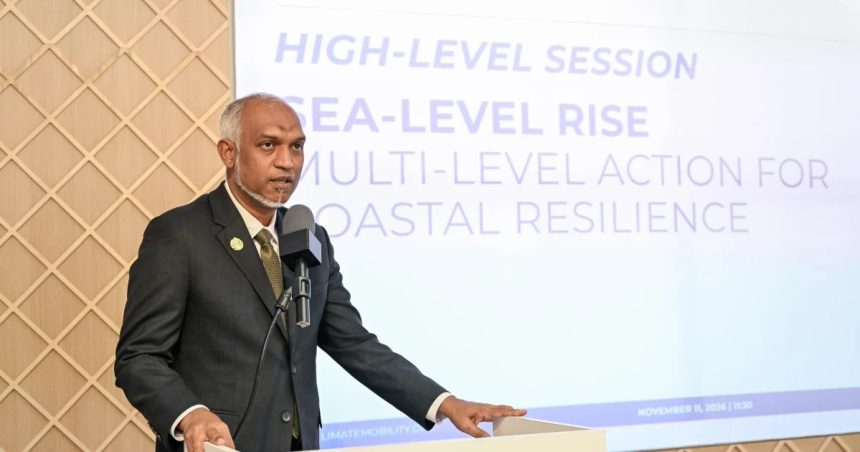
President Dr Mohamed Muizzu has said that rising sea levels caused by global warming are not a distant threat for the Maldives, but a development challenge already tied to the country’s very survival.
Speaking at a COP31 high-level session titled “Sea-Level Rise: Multi-Level Action for Coastal Resilience”, the President said the islands of the Maldives are not just land. They are the homes, history and identity of Maldivians.
He described the loss of even a small part of the country’s territory as something that would undermine the sovereignty of the Maldives.

The President said the Maldives’ priority is to guarantee the right of Maldivians to remain on their islands. To that end, the government is carrying out special work to protect island shorelines and safeguard lagoons and reefs.
“To do this successfully, communities must have access to the information and finance they need to adapt to climate change,” the President said.
He said building resilience is the most important national effort to reduce the impact of climate change, pointing to Hulhumalé as a strategic asset developed with that aim.
Referring to Rasmalé, now under development, the President said the island has been designed to sit higher than projected sea-level rise, as a low-carbon, environmentally friendly city powered by renewable energy.
“These islands reflect the belief that climate adaptation must be built into development itself, not something done in response to a disaster,” he said. He described this as the core of his vision to make the Maldives a developed nation.
The President said a developed Maldives must be a resilient Maldives, and that climate vulnerability must not be allowed to decide the country’s future.
He called on the international community to increase financial support and make adaptation funding fair and adequate. He stressed that climate finance for developing countries must be grant-based, saying it is not charity but climate justice.