

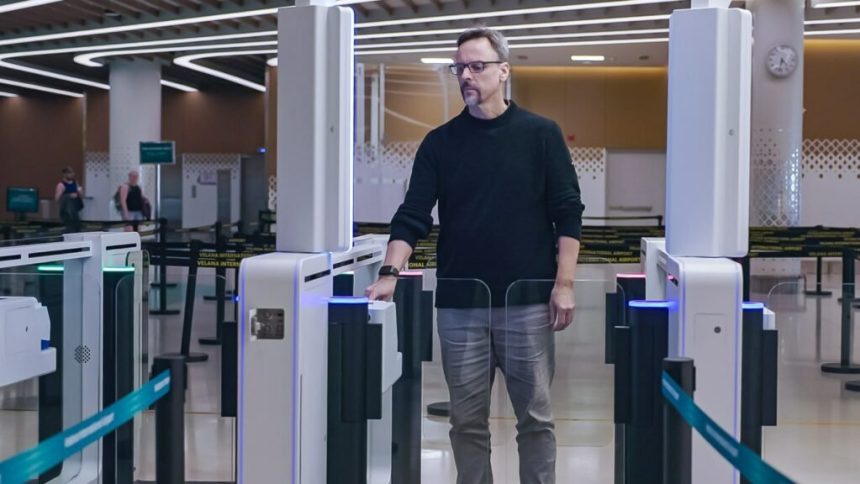
Velana International Airport (VIA) has begun offering immigration clearance to foreign tourists through 35 e-gates installed at its terminal.
Until now, e-gate clearance at the airport was available only to Maldivians. With the service now expanded, 20 e-gates are in operation at arrivals and 15 at departures.
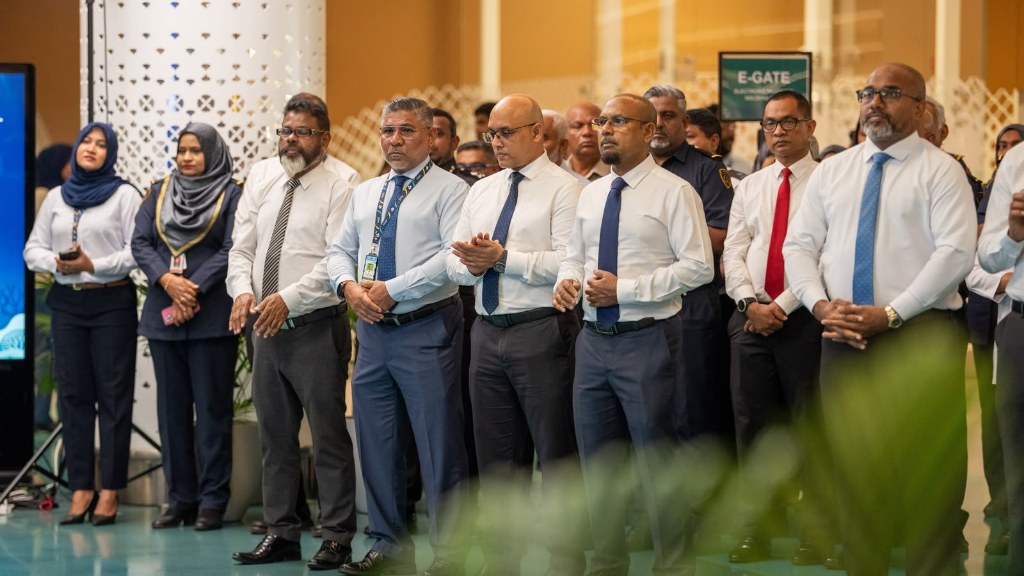
Minister of Homeland Security and Technology Ali Ihusaan launched the expanded service at a ceremony held at Velana International Airport today.

The service was previously limited to Maldivians travelling on electronic passports. Opening it to foreign travellers makes the Maldives the first country in the South Asian region to offer automated, seamless immigration clearance to foreigners on this scale.
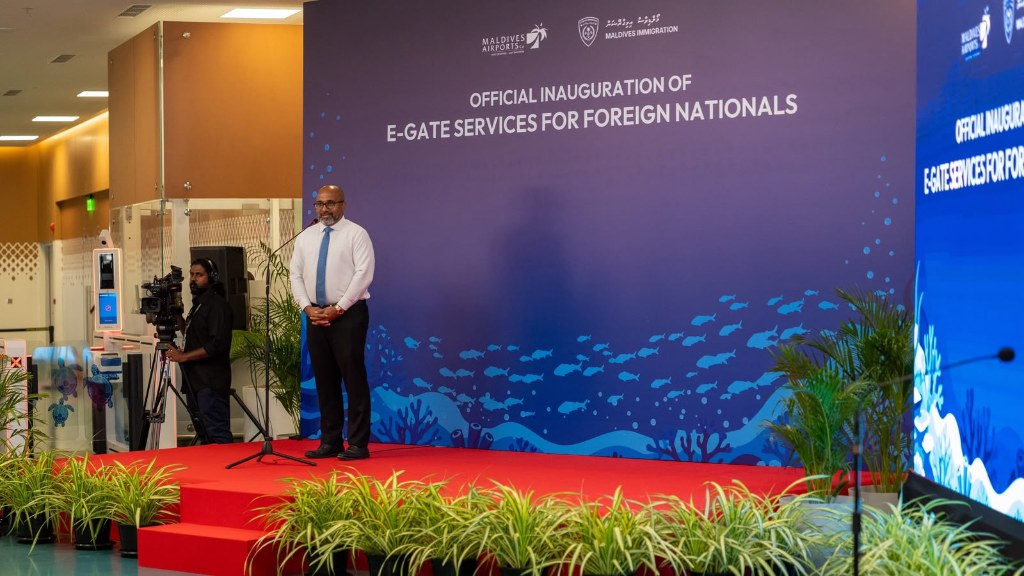
Speaking at the ceremony, Controller of Immigration, retired Commissioner of Police Ahmed Fazeeh, said President Dr Mohamed Muizzu has worked hard to make airport services easier for travellers. He said the e-gate project was initiated by the President, and involved demanding technical work.
Fazeeh said an international company was contracted to install the gates, and carried out extensive work on the project.
Minister Ihusaan noted that e-gates are used in developed countries around the world. He said travellers who enter through the e-gates will not need to have their passports stamped when they depart.
“This is a very important step for a small country like ours,” he said.
The minister said the service is part of the implementation of Maldives 2.0, under the leadership of President Muizzu.
“The end result of this work is to ensure that everyone entering through our borders is verified for safety, security and other requirements, while recognising that the Maldives is a tourism destination, and that the service is delivered as quickly as possible,” he said.
He said the Maldives is the first country in the region to offer the service at this level.
“Singapore also does this, but the range of countries allowed is not as wide. With this seamless setup, once a person has entered on a passport, even a tourist, they will have a seamless experience entering the Maldives as long as there are no additional security concerns,” he said.
The minister explained that from the moment a traveller checks in abroad, a notification will be sent through the IMUGA system confirming they can use the e-gates. An e-visa will be issued as soon as they clear the e-gate.
“The biggest difference is that a process that took between 30 and 50 seconds at an immigration counter is now completed in five to 10 seconds,” he said.
Maldives Immigration said that for a country visited by thousands of tourists every day, the service is a very important solution for reducing the time spent on immigration clearance.
In the first phase, holders of passports from 46 designated countries, and passengers of the 31 airlines that have joined the service so far, can complete immigration through the e-gates.
The system uses the latest biometric technology. It verifies identity through facial recognition and iris scanning and confirms the validity of the passport. Each passenger is cleared in about six to seven seconds.
This is expected to sharply reduce waiting times in immigration queues, especially during the airport’s peak hours.
The gates use advanced biometric verification that recognises facial and iris features and matches them against the data stored in the electronic passport.
The system also uses Passive Authentication (PA), to verify the data on the passport chip, and Active Authentication (AA), to confirm the chip is genuine. These measures prevent identity fraud and strengthen border security.
Immigration said that once foreigners arriving on tourist visas complete clearance at a counter or e-gate, an automated e-visa will be issued.
The visa details and permitted length of stay are sent instantly to the email address the traveller gave when completing the Traveller Declaration form on the IMUGA portal. The visa is cancelled automatically when the tourist leaves the Maldives.
The expanded e-gate service is a major step forward in Immigration’s efforts to modernise border management and speed up its work.