

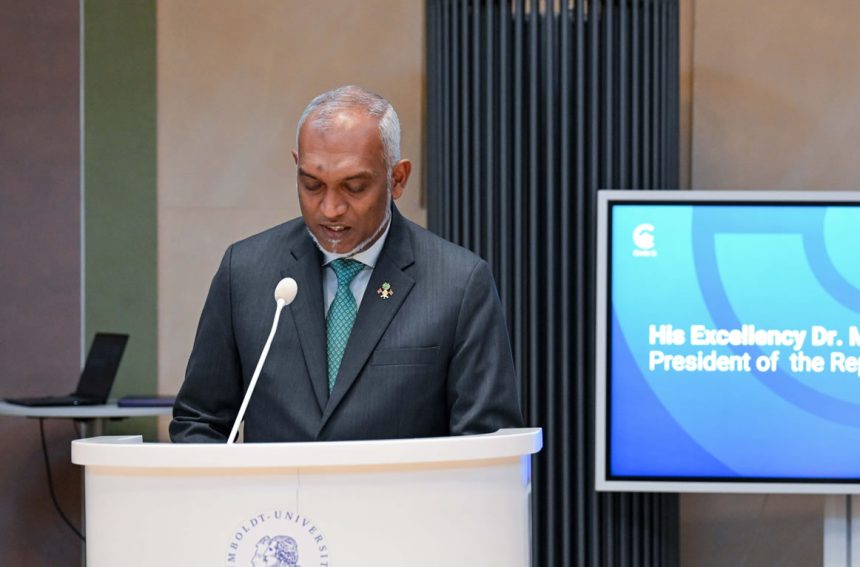
President Dr. Mohamed Muizzu has called for urgent and equitable global action on climate change, warning that the crisis poses an existential threat to low-lying island nations such as the Maldives.
Delivering a keynote address at Humboldt-Universität zu Berlin during his official visit to Germany, the President spoke before academics and students, highlighting the disproportionate burden faced by countries that contribute minimally to global greenhouse gas emissions.
He told the audience that the Maldives, despite its negligible share of emissions, remains among the nations most severely impacted by rising sea levels and climate-related risks. Framing adaptation as a matter of survival rather than choice, President Muizzu said the nation’s culture, identity and sovereignty hinge on decisive international measures.

The President stressed that climate risk considerations must be embedded into national planning and budgeting processes, guided by scientific evidence. He urged the international community to significantly scale up climate finance, describing predictable, adequate and concessional funding as essential for vulnerable states.
Positioning adaptation financing as an issue of climate justice, he argued that nations facing the gravest threats should not be left to shoulder the costs alone.
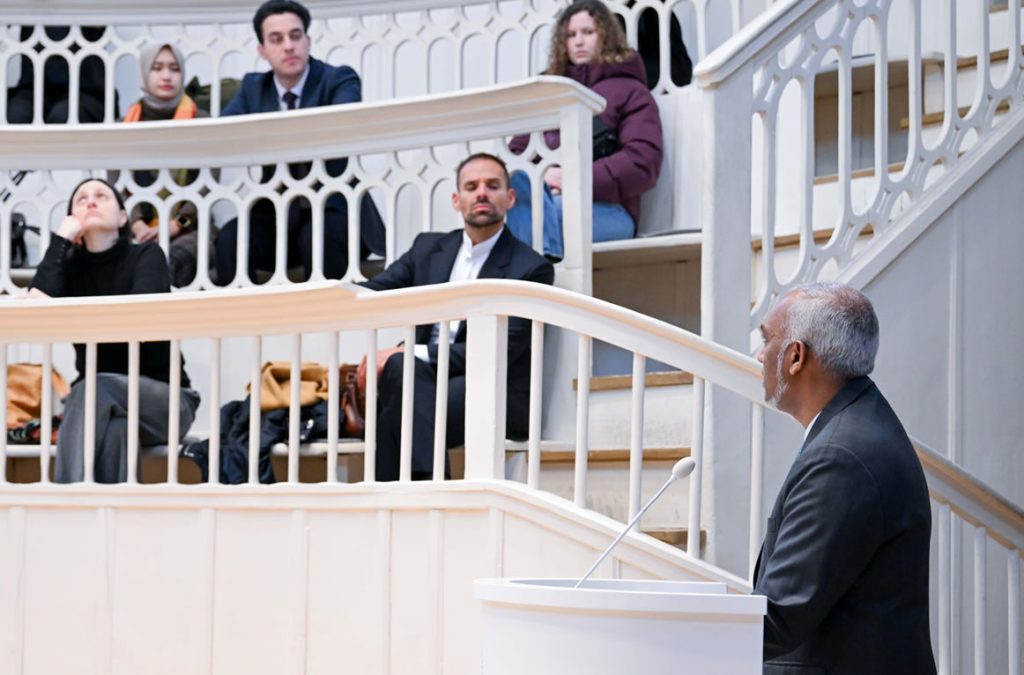
Drawing on the Maldives’ experience, President Muizzu cautioned that delaying adaptation efforts ultimately increases long-term economic and social costs. He highlighted the importance of empowering local communities and underscored the value of natural ecosystems — including coral reefs and mangroves — as cost-effective and resilient defences against climate impacts. Adaptation, he said, must align closely with sustainable development goals.
Addressing the academic community, the President noted that institutions such as Humboldt University play a critical role in connecting science and policymaking, amplifying the voices of vulnerable countries and countering climate misinformation. “A crisis without borders requires knowledge without borders,” he said.
During a question-and-answer session following the address, President Muizzu also discussed sustainable tourism initiatives and the Maldives’ energy transition efforts. He called for stronger cooperation among Small Island Developing States and urged major emitting countries to expand mitigation and adaptation support for those at greatest risk.