

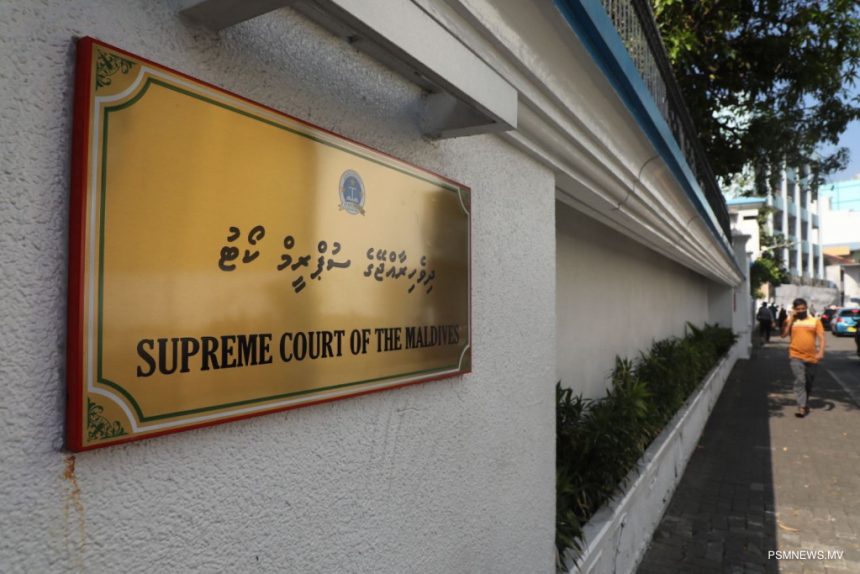
The Supreme Court has cleared the way for a national referendum on synchronising presidential and parliamentary elections, rejecting last-minute legal challenges and setting the stage for a politically charged vote on April 4.
The referendum will be held alongside Local Council and Women’s Development Committee (WDC) elections, asking voters to decide on a proposed constitutional amendment to align both national elections on the same day.
Delivering a unanimous verdict, Chief Justice Abdul Ghanee Mohamed ruled that there are no constitutional or legal barriers to proceeding with the referendum. He emphasised that Maldivian law does not mandate a specific format for referendum questions, dismissing arguments that the wording was unconstitutional.

The case was filed by lawyers Aik Ahmed Easa and Ibrahim Shiyam in their personal capacity, although both are affiliated with the opposition Maldivian Democratic Party. The court rejected their bid to halt the vote.
The ruling comes amid a clear political divide. The Maldivian Democratic Party has openly opposed both the holding of the referendum and the proposed synchronisation of elections, while the ruling administration led by President Dr Mohamed Muizzu is pushing forward with the initiative.
Earlier attempts by the opposition party to block the referendum through the Civil Court and High Court were also unsuccessful, with both courts declining to accept the cases.
The five-member Supreme Court bench, which also included Justice Ali Rasheed, Justice Dr. Mohamed Ibrahim, Justice Hussain Shaheed, and Justice Abdulla Hameed, ruled unanimously that there are no grounds to stop the vote.
With the legal hurdle removed, Maldivians are now set to decide on April 4 whether to endorse a major electoral reform that could reshape the country’s political calendar.