

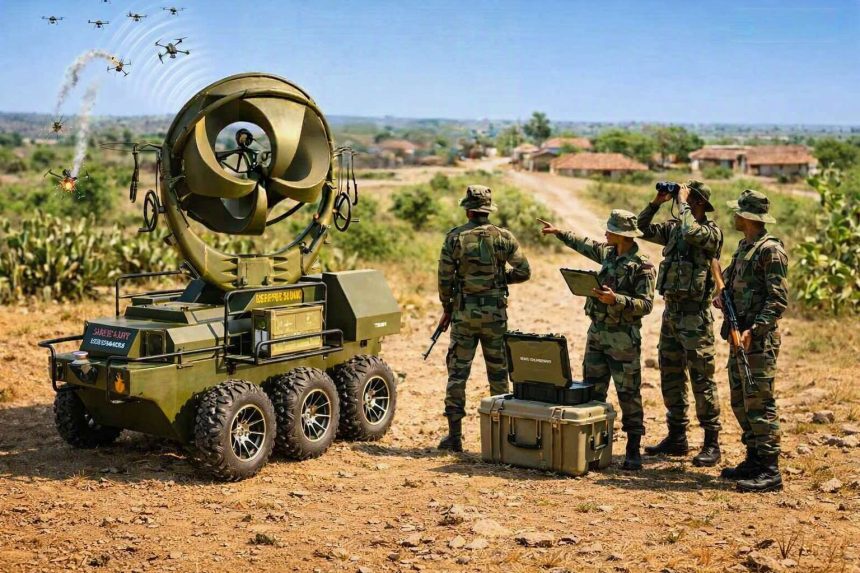
Indian scientists have developed an acoustic counter-drone system capable of destabilising unauthorised drones using targeted sound waves, potentially giving India another weapon against the growing threat posed by small and inexpensive unmanned aircraft.
The system, developed by scientists at the Central Scientific Instruments Organisation (CSIO) in Chandigarh, can disrupt drones without firing ammunition, using lasers or interfering with their radio communications, according to The Economic Times. The project received funding from IHUB-NTIHAC, a technology innovation and cybersecurity hub at IIT Kanpur.
Instead of attacking the communication link between a drone and its operator, the technology targets the aircraft’s internal MEMS gyroscopes. These tiny sensors measure rotational movement and provide information that allows the flight computer to keep the aircraft stable.

Specialised acoustic transducers direct high-intensity sound at frequencies capable of interfering with the sensors. When exposed to the targeted frequency, the gyroscope can produce false readings, prompting the flight controller to make unnecessary corrections. The resulting instability can cause the drone to wobble, drift or fall from the sky.
Because the technique attacks the drone’s internal sensing system rather than its radio connection, it could also work against autonomous drones that do not require continuous communication with an operator. This gives the technology an important advantage over conventional radio-frequency jammers in certain scenarios.
The development comes as India increasingly focuses on counter-drone capabilities following the rapid expansion of unmanned warfare. Small drones have also been used for cross-border trafficking of narcotics, weapons and counterfeit currency, while the extensive use of unmanned systems during Operation Sindoor highlighted their growing military importance.
CSIO’s official project records confirm an ongoing programme titled “System design for acoustic-based attack on UAV and its mitigation mechanism,” funded by IHUB-NTIHAC at IIT Kanpur. The project began in July 2024 and is listed as running until July 2027.
The technology is expected to complement existing counter-drone systems rather than replace radar, electronic warfare and other interception methods. Acoustic approaches are particularly relevant to small drones, which can be difficult for conventional sensors to detect in complex environments.
CSIO is now seeking industry partners capable of taking the technology towards commercial manufacturing and deployment, potentially opening the way for the system to become another layer in India’s expanding counter-drone architecture.