

President Dr Mohamed Muizzu has ratified amendments to the Goods and Services Tax Act that will bring foreign tour operators, travel agents and offshore booking platforms selling Maldives tourism products within the country’s GST framework.
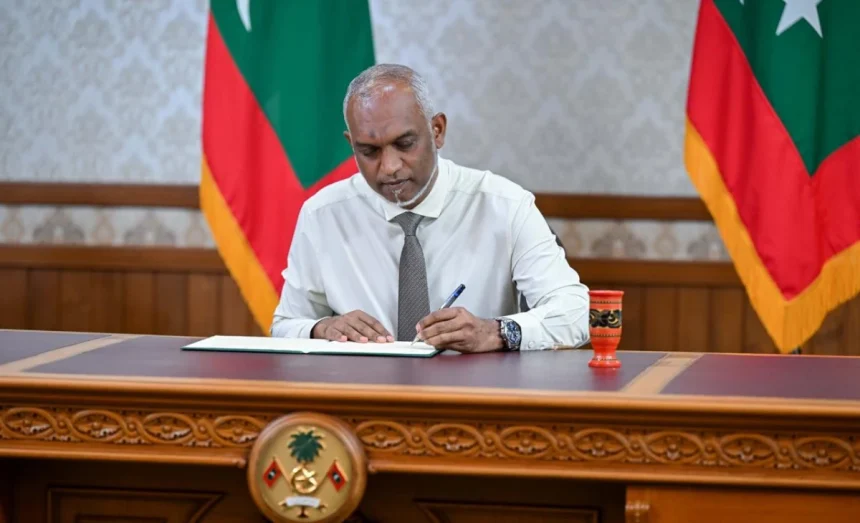
The amendments, which were passed by Parliament on August 23, were ratified at a special ceremony held at the President’s Office.
The government expects the changes to generate an additional MVR 1.6 billion in annual state revenue, with GST collection under the new provisions scheduled to begin in October.

A key component of the amendments is the introduction of the destination principle into the GST framework, allowing the Maldives to tax certain goods and services based on where they are consumed or supplied rather than solely on whether the business providing them has a permanent establishment in the country.
This will enable GST to be imposed on foreign businesses selling inbound tourism products connected to the Maldives even when those companies do not maintain a permanent taxable business presence in the country.
Under the amended law, inbound tourism products include tourism-related services provided in the Maldives, such as accommodation, food and beverage services and transportation.
The changes are particularly significant for offshore booking platforms, foreign tour operators and travel agents that facilitate or sell Maldives tourism products from outside the country.
The amendments also establish broader criteria for determining when a service is considered to have been supplied in the Maldives.
A service provided through a business establishment located in the country will be treated as a domestic supply. Services may also be considered to have been provided in the Maldives when the work is physically performed by a person in the country at the time the service is delivered, even if the business itself is not registered locally.
Services connected to immovable property located in the Maldives will similarly be regarded as services supplied within the country.
The government introduced the amendments as part of efforts to address gaps and implementation challenges within the existing GST regime while strengthening the country’s ability to collect tax from economic activity connected to the Maldives but conducted through businesses based overseas.
The measure has particular relevance to the tourism industry, where international tour operators, travel agents and online booking platforms play a major role in connecting overseas travellers with Maldivian resorts, guesthouses and other tourism services.
By extending GST obligations to qualifying foreign businesses without requiring them to have a permanent establishment in the Maldives, the government aims to capture a larger share of tax revenue from transactions involving tourism products ultimately consumed within the country.
The changes also form part of broader efforts to strengthen domestic revenue collection at a time when the government has been seeking to improve public finances and increase revenue generated from major sectors of the economy.
With implementation scheduled to begin in October, the government estimates the expanded GST framework will contribute approximately MVR 1.6 billion each year to state revenue.