

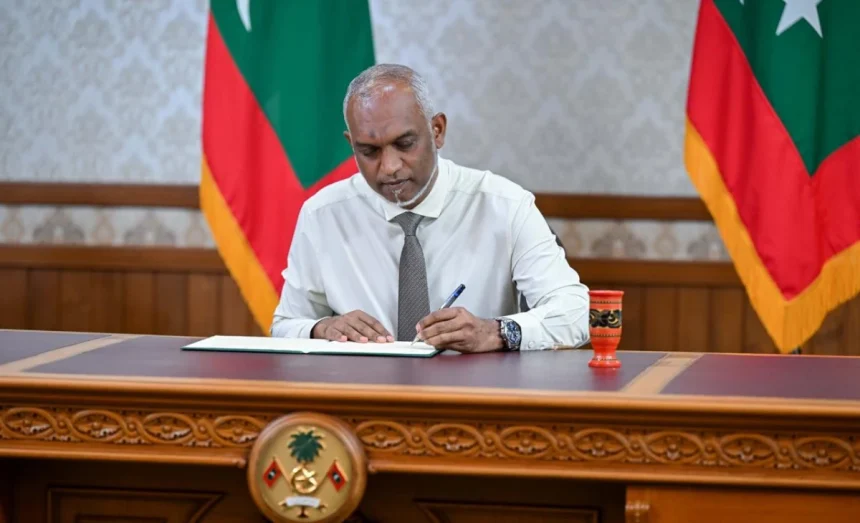
President Dr Mohamed Muizzu has ratified legislation establishing a new framework for the allocation and leasing of uninhabited islands and standalone lagoons in the Maldives, including revised rental rates based on how the land is used.
The Bill on Leasing Uninhabited Islands and Lagoons was submitted to Parliament by North Thinadhoo MP Saudulla Hilmy and passed on August 26, 2026.
The legislation introduces rules governing how uninhabited islands and lagoons can be designated, allocated and leased for economic, industrial and social purposes, while also defining the respective responsibilities of the central government and local councils.

A key change under the new law is the replacement of the previous rental rate of 10 laari per square metre with different rates based on the purpose for which an island is leased.
Under the revised structure, uninhabited islands leased for industrial and economic activities will carry a rent of MVR 3 per square metre, while those allocated for fisheries and agriculture will be charged MVR 2.50 per square metre.
Islands used for social purposes will carry a rate of MVR 2 per square metre.
The legislation also establishes a framework for granting currently unallocated islands under the traditional “varuvaa” arrangement, where an island is entrusted to a party for its maintenance. Islands provided under this arrangement will be subject to an annual fee of MVR 2 per square metre.
According to the legislation, the revised rates are intended to replace the longstanding uniform rental structure with a system that better reflects different uses of state land and the country’s changing economic circumstances.
The Act also determines which authorities will have responsibility for allocating uninhabited islands and lagoons.
Islands and standalone lagoons designated for various purposes may be allocated by the President. However, uninhabited islands falling within the jurisdiction of a local council will generally be allocated by the respective council.
There are exceptions to that arrangement. Islands designated for tourism, industrial development or State purposes will continue to fall under the authority of the relevant national institutions rather than being allocated by councils.
The new framework is primarily concerned with the use of uninhabited islands for purposes other than tourism, while preserving the existing role of the relevant authorities in allocating islands specifically for tourism development.
Uninhabited islands are used for a range of activities across the Maldives, including agriculture, fisheries-related operations, industrial activities and community purposes. Their allocation has also been an important issue for island councils seeking greater involvement in the management and economic use of resources within their jurisdictions.
The new legislation seeks to establish clearer legal procedures for such allocations, including how islands and lagoons are designated for particular uses, the conditions attached to leases and arrangements for maintaining islands that have not otherwise been allocated.
The Act will take effect 30 days after its ratification and publication in the Government Gazette.
Once it comes into force, the legislation will repeal the Law on Uninhabited Islands of the Maldives (Act No. 20/98), replacing the previous framework with the newly established system.