

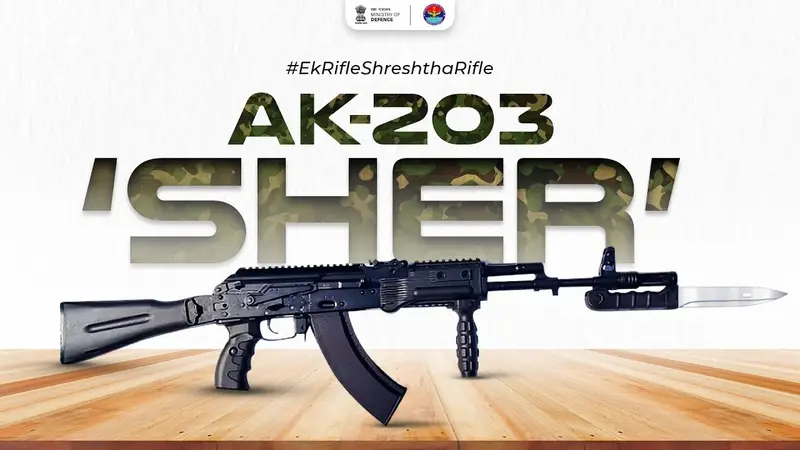
India has reached a major milestone in its drive for defence self-reliance after achieving full domestic production of the AK-203 “Sher” assault rifle, an advanced Kalashnikov-pattern weapon that is set to become a key service rifle of the Indian Army.
The development is being promoted as an important achievement under the “Make in India” initiative, particularly because the AK-203 is now being manufactured using Indian components and input materials rather than relying on imported parts.
The rifle, whose “Sher” name means Tiger, is expected to replace ageing Indian National Small Arms System (INSAS) rifles that have faced criticism over reliability.

Problems with the INSAS became particularly prominent during the 1999 Kargil War. Indian troops fighting in freezing, high-altitude conditions reported issues including weapon jams and magazines cracking.
AK-203 passes key test in Amethi
The locally produced AK-203 was successfully test-fired on August 23 at the manufacturing facility in Amethi, Uttar Pradesh, marking another step towards its wider induction into the Indian military.
Indo-Russian Rifles Private Limited, established in 2019 as a joint venture involving India and Russia, is responsible for manufacturing the weapon. The company is reportedly preparing to submit the rifle for Indian Army trials this month.
Former Indian Army Deputy Chief of Staff Rakesh Kapoor said achieving end-to-end manufacturing represented more than simply producing another rifle.
According to Kapoor, the programme has helped India develop expertise across areas including metallurgy, precision engineering, quality control and weapons testing.
He described the AK-203 programme as evidence that India can absorb sophisticated foreign technology and establish the industrial capability necessary to manufacture the complete product domestically.
The achievement is particularly significant given India’s historically deep dependence on Russian military technology. Russian-origin equipment remains prominent throughout India’s armed forces, including Su-30MKI fighter aircraft and several naval platforms.
India has nevertheless been working to diversify its military suppliers, purchasing equipment from countries including France, Israel and the United States while simultaneously expanding domestic defence production.
Russia’s continuing war in Ukraine has further highlighted the strategic importance of diversified and resilient defence supply chains.
Lighter rifle with greater range
The AK-203 also represents a substantial change from the INSAS.
The rifle reportedly weighs approximately 3.6kg to 3.8kg, around 600 grams less than the INSAS, while offering an effective range of up to 800 metres.
It also uses the larger 7.62mm cartridge associated with the Kalashnikov family, providing Indian troops with greater stopping power compared with the smaller-calibre ammunition used by the INSAS.
The reputation of Kalashnikov-pattern rifles for operating reliably in difficult environments has made the AK-203 particularly attractive for Indian requirements, including counter-insurgency operations.
India’s armed forces operate across dramatically different environments, ranging from Himalayan glaciers and high-altitude mountain regions to deserts, forests, plains and tropical coastal areas. This makes reliability under extreme temperatures and environmental conditions particularly important.
Former Indian Army Brigadier Sanjay Iyer said initial feedback, including from personnel operating around the Siachen Glacier, had been positive.
However, he cautioned that India would need to maintain strict manufacturing and ammunition quality standards to avoid repeating some of the problems experienced with the INSAS.
Issues encountered during the Kargil conflict were not necessarily limited to the rifle itself, with ammunition and lubricants supplied by ordnance factories also contributing to reliability concerns, according to Iyer.
From 25% to 100% Indian content
Localisation of the AK-203 has advanced rapidly.
Indigenous content reportedly stood at around 25% in July 2024 before reaching approximately 50% during 2025. India has now achieved complete local manufacturing, with more than 100 medium and small enterprises reportedly participating across the weapon’s domestic supply chain.
Kapoor said the use of entirely Indian components and materials demonstrates that the country has successfully developed a manufacturing ecosystem around the Russian design.
More than 601,000 AK-203 rifles are expected to be delivered by December 2030, according to a Press Trust of India report citing a senior official. That would put production ahead of the contractual delivery deadline of October 2032.
However, experts have drawn an important distinction between manufacturing independence and ownership of the rifle’s underlying design.
Iyer noted that while producing the entire weapon domestically represents a major industrial accomplishment, the AK-203 remains based on Russian intellectual property. India’s ability to independently redesign or export the weapon therefore remains subject to the arrangements governing the Indo-Russian joint venture.
Export potential
The economics of domestic production could also prove significant.
The Indian-made AK-203 is estimated to cost at least 25% less than imported versions, potentially making it attractive not only for the military but also for Indian police and other security agencies.
Exports could eventually become another market for the rifle, with potential overseas sales reportedly possible from around 2030, subject to applicable agreements and approvals.
India’s wider small-arms export industry has already expanded considerably. Small-arms exports reportedly increased from approximately 7.79 billion rupees in the 2018 financial year to 72.16 billion rupees in the 2025 financial year, representing close to a tenfold increase.
For New Delhi, the AK-203 programme therefore carries significance beyond replacing the INSAS.
It represents an attempt to combine Russian weapons technology with India’s rapidly expanding defence manufacturing base, while reducing vulnerability to foreign supply disruptions and building a domestic industrial ecosystem capable of supporting one of the world’s largest armed forces.