

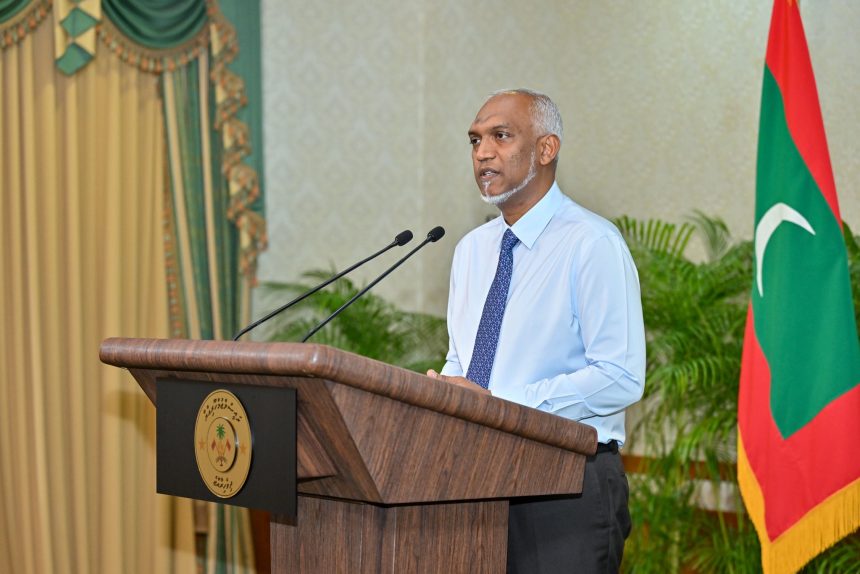
President Dr Mohamed Muizzu has announced plans to establish a National Oil Reserve, positioning it as a critical long-term safeguard to protect the country’s energy security amid escalating instability in the Middle East.
Speaking at a press briefing at the President’s Office, Muizzu confirmed that feasibility studies and technical assessments are already underway, with the project structured into three phases across different regions of the Maldives. Each phase is expected to take between one and a half to two years, with the full initiative targeted for completion within four to five years.
The President underscored the urgency of the move, noting the Maldives’ heavy dependence on imported fuel. “Fuel remains one of the most essential resources for the nation. Establishing a national reserve is a strategic priority to ensure long-term stability,” he said.

According to the government’s estimates, each phase of the project will require an investment of approximately $150 million. Authorities have pledged that development will proceed with careful consideration of environmental impacts and sustainability benchmarks.
The policy shift follows heightened concerns triggered by ongoing conflict in the Middle East, a region central to global energy supply chains. A special ministerial committee convened by the administration has been tasked with assessing economic vulnerabilities and ensuring uninterrupted access to essential commodities.
Finance Minister confirmed that the Maldives currently maintains sufficient fuel reserves, while efforts are being intensified to diversify supply routes. This includes exploring additional fuel shipments from Singapore alongside existing imports from Oman.
Beyond energy security, the geopolitical fallout is already impacting the country’s tourism-dependent economy. The President revealed that tourist arrivals have dropped by 21 percent in the 20 days since the conflict began, with approximately 31 percent of visitors typically transiting through Middle Eastern hubs.
The government is now advancing mitigation strategies to stabilize arrivals and sustain economic momentum, as the Maldives navigates the dual pressures of global conflict and domestic energy vulnerability.