

President Dr Mohamed Muizzu’s administration has repaid about USD 1.29 billion in foreign debt during its first two and a half years, while continuing to service obligations signed under successive Maldivian governments, according to figures presented by the President on June.
The latest major payment came on September 17, when the government settled the final USD 50 million of a USD 150 million State Bank of India Treasury bill facility obtained in 2019 during former President Ibrahim Mohamed Solih’s administration. The Ministry of Finance confirmed that the payment completely cleared the facility.
The facility was repaid in three USD 50 million installments by the current administration, in January 2024, May 2024 and September 2026.
The SBI settlement follows another major external payment this year. In April, the Maldives settled the USD 500 million sovereign Sukuk, together with associated coupon payments. The Maldives Monetary Authority said the payment was funded through a combination of official reserves and the Sovereign Development Fund.
$1.29 billion paid in two and a half years
President Muizzu has said his administration paid approximately USD 1.29 billion in foreign debt during its first two and a half years, as the government confronted a heavy external repayment schedule.
In May, the President said the Maldives had paid nearly USD 1 billion in outstanding debt in around 40 days alone, including the Sukuk-related payment.
The government has combined direct repayments with debt restructuring, refinancing negotiations, reserve accumulation and increased allocations to the Sovereign Development Fund as part of its broader debt-management strategy.
Direct external debt service profile shows where obligations originated
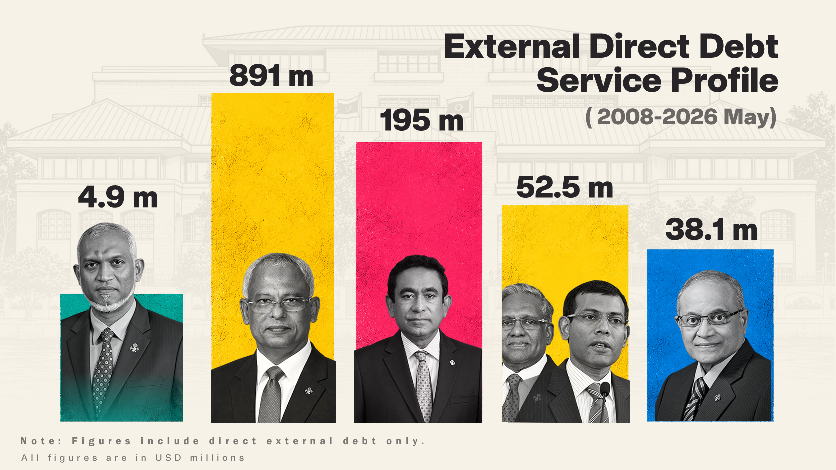
Separate figures presented by President Muizzu provide further detail on the country’s direct external debt service, classified according to the administration under which the respective debt was signed and the period in which payments were made.
The figures form part of an External Direct Debt Service Profile covering 2008 to May 2026.
According to the profile, USD 891 million in direct external debt service was associated with obligations signed during the administration of former President Ibrahim Mohamed Solih.
Another USD 195 million was associated with debt signed during former President Abdulla Yameen Abdul Gayoom’s administration.
Debt signed during the administrations of former Presidents Mohamed Nasheed and Dr Mohamed Waheed Hassan accounted for USD 52.5 million in direct external debt service, while USD 38.1 million was associated with debt signed during former President Maumoon Abdul Gayoom’s administration.
The profile attributed USD 4.9 million in direct external debt service to debt signed during the current Muizzu administration.
These figures total approximately USD 1.18 billion. They should not be interpreted as an administration-by-administration allocation of the entire USD 1.29 billion repayment figure because the profile covers a specific category of liabilities.
The figures include direct external debt only and represent total external direct debt service by signing administration and payment period under the External Direct Debt Service Profile for 2008 to May 2026.
SBI debt signed under Solih administration now cleared
The latest USD 50 million SBI payment removes one of the outstanding facilities originating during the Solih administration from the government’s repayment schedule.
The USD 150 million budget-support facility was obtained through SBI in 2019. The Finance Ministry said the current administration has now paid the entire amount through the three USD 50 million settlements.
The Ministry said debt management is being undertaken through advance financial planning, including regular deposits into the Sovereign Development Fund and arrangements made ahead of maturity dates.
Sovereign Development Fund transformed into debt repayment buffer
The Sovereign Development Fund (SDF) has become a major component of the administration’s preparations for large foreign currency repayments.
In his 2026 Presidential Address, President Muizzu said the SDF’s usable balance was only about USD 2 million when his administration assumed office. He said that by early 2026, foreign currency holdings in the fund had risen above USD 275 million.
Official Finance Ministry figures provide another snapshot of that expansion. As of September 2025, SDF assets totalled approximately MVR 10.94 billion, including USD 350 million in dollar-denominated assets. The dollar component included USD 246 million in domestic securities and USD 103.3 million in cash.
The accumulation continued as the USD 500 million Sukuk maturity approached.
On March 2, President Muizzu said the SDF held more than USD 320 million, while another USD 330 million was available as usable reserves. He said more than USD 650 million had been set aside ahead of the Sukuk repayment.
The MMA subsequently confirmed that the USD 500 million Sukuk was settled on April 2, including associated coupon payments, using a combination of official reserves and the SDF.
The transaction demonstrated the SDF’s practical role as a foreign currency buffer for sovereign obligations rather than merely a reserve accumulated for future use.
The Finance Ministry reiterated that strategy after settling the SBI facility, saying the government regularly deposits money into the SDF while arranging financing in advance of upcoming debt maturities.
Foreign exchange measures contribute to external buffers
The administration has also linked its foreign exchange reforms with efforts to increase official foreign currency holdings.
In his Presidential Address, President Muizzu said the Maldives generated USD 1.2 billion in foreign currency revenue in 2025, enabling greater allocations to the SDF and supporting official reserves.
He also said USD 492 million was exchanged through the Maldives Monetary Authority during 2025 following implementation of the government’s foreign exchange framework.
These measures have been implemented as the government attempts to meet substantial external obligations while maintaining sufficient dollars for an economy heavily dependent on imported fuel, food, medicine and other essentials.
Reserves remain after major repayments
Despite the large payments made during 2026, the Finance Ministry said Maldives’ official reserves stood at approximately USD 644 million at the end of August.
That figure came after the USD 500 million Sukuk settlement and other foreign currency obligations paid earlier in the year.
The Ministry said arrangements were in place to maintain foreign currency availability for essential imports despite the country’s debt repayments.
The government’s challenge remains substantial. Debt accumulated across multiple administrations continues to mature, while the current administration has also taken on new obligations.
The latest SBI settlement nevertheless removes another USD 150 million facility from the repayment schedule. Together with the Sukuk settlement and the expansion and use of the SDF, it illustrates the administration’s current approach of building foreign currency buffers ahead of maturities, directly servicing obligations when they fall due, and seeking restructuring or refinancing where appropriate.