

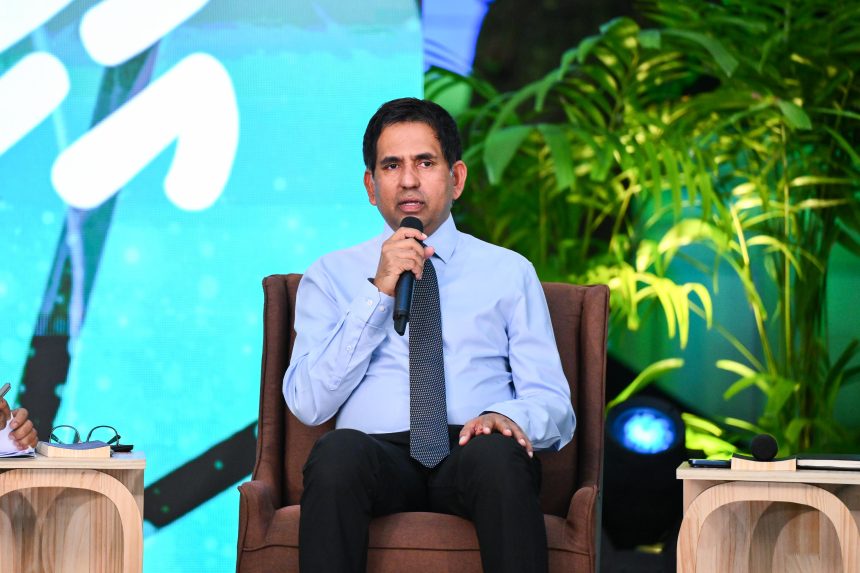
The Ras Malé development planned with UAE-based Eagle Hills could generate returns equivalent to what the Maldives has received from more than five decades of tourism development, Economic Development, Trade and Transport Minister Mohamed Saeed has said.
Speaking at the government’s Ahaa public forum, Saeed used the comparison to underline the scale of the Maldives Waterfront and Marina project, which the administration has positioned as a major component of its strategy to expand and diversify the economy.
According to the minister, the direct economic contribution generated through the development of around 170 tourist resorts over the Maldives’ 54-year tourism history stands at approximately USD 1.7 billion.

Saeed said the scale of revenue expected from the Eagle Hills development would be comparable to those cumulative returns.
The minister argued that while tourism transformed the Maldivian economy over the past five decades, maintaining the existing pace and model of development would not be sufficient for the country to achieve its ambition of becoming a developed economy by 2040.
Large-scale investments, he said, are therefore necessary to generate new sources of state revenue, meet growing expenditure and create additional areas of economic activity.
The government signed a commercial terms agreement with Eagle Hills for the Maldives Waterfront and Marina development in Ras Malé earlier this year.
The project is planned across approximately 500 hectares and is envisioned as an international-standard waterfront development incorporating tourism, residential, commercial and leisure components.
Government projections have placed the initial direct investment associated with the development at around USD 20 billion, with officials saying the wider project could ultimately attract more than USD 30 billion in foreign direct investment over its development period.
Saeed said the project is also expected to significantly increase tourism capacity, potentially bringing an additional one million visitors to the Maldives annually.
He linked those expectations to the expansion and modernisation of Velana International Airport, saying the country’s main international gateway is being developed with future annual tourist arrivals of between four million and five million in mind.
The Maldives welcomed its first tourists in 1972, beginning an industry that would eventually become the backbone of the national economy. Tourism remains the country’s largest source of foreign currency and one of the most important contributors to government revenue.
Saeed, however, cautioned against an economy being overly dependent on a single industry, arguing that diversification is necessary to reduce the risks created by heavy reliance on tourism.
He said diversification should still be designed around the Maldives’ geographical and economic strengths rather than attempting to replicate economic models used elsewhere.
Real estate and large-scale urban development have increasingly featured in the government’s plans to broaden investment opportunities beyond the traditional resort model.
Addressing questions surrounding long-term leases, Saeed also said allowing tourism properties to secure leases of up to 99 years is not a policy introduced specifically for the Eagle Hills development.
According to the minister, the policy originated between 2013 and 2018, while subsequent legislative changes established the framework through which resort leases could be extended to 99 years.
Around 54 resorts are currently operating under 99-year leases, he said.
Saeed argued that while tourism investments in the Maldives are substantial when measured against the size of the domestic economy, their asset values are comparatively smaller when viewed against major developments undertaken internationally.
He said projects on the scale of the Eagle Hills development could provide the type of investment required to produce a more significant structural change in the economy.
The Ras Malé project is among the largest developments proposed in the Maldives and forms part of the government’s broader plans for the newly reclaimed area.
While the government has highlighted the project’s projected investment, tourism and revenue benefits, its ultimate economic contribution will depend on the development being implemented at the proposed scale and according to its planned timeline.