

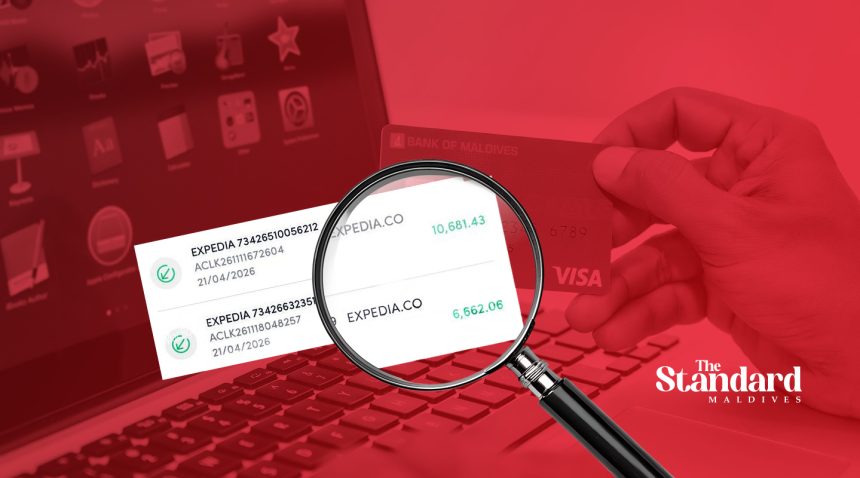
For many Maldivians, the frustration feels familiar. A purchase is made overseas or on an international website, the amount looks straightforward at checkout, and then the final figure that appears on the bank statement ends up slightly higher than expected. In recent weeks, that gap has fueled fresh speculation on social media, with some users alleging that hidden charges are being added by local banks. But the reality is more technical, and far less mysterious, than many assume. Bank of Maldives’ published schedule says cross-border card transactions made in currencies other than US dollars are converted into the card’s billing currency at an exchange rate determined by the relevant card network, and that such transactions are subject to a fee of up to 10 percent on the transaction amount.

At the centre of the confusion is a simple misunderstanding: many customers see their bank as the only institution involved in a foreign transaction, when in fact an international card payment passes through several players before it is completed. When a Maldivian cardholder pays for a hotel abroad, shops on a foreign website, or uses a card at an overseas terminal, the payment does not move directly from the customer’s account to the merchant. It travels through an international card network such as Visa, Mastercard or American Express, and may also involve foreign banks and overseas payment processors before the transaction is finally settled. Visa itself says it provides daily foreign exchange rates used within VisaNet for cross-border and multicurrency transactions, while American Express explains that foreign transaction fees can apply when a purchase is made in a foreign currency or when a transaction is processed through a foreign bank.
That is the first point the public needs to understand: a foreign card transaction is not just a local bank service. It is an international payment service involving global brands, global infrastructure and global pricing mechanisms. BML does not own Visa, Mastercard or American Express, nor does it control how those international card schemes determine exchange rates or apply their own processing structures. BML’s own tariff document explicitly states that the exchange rate applied to cross-border card transactions is determined by the respective card network, not by the bank itself.
A second point often lost in online debate is the difference between a purchase amount and a settlement amount. Suppose a customer in Maldives uses a rufiyaa-linked card to pay USD 100 for goods or services. The merchant charges in dollars, but the customer’s underlying account is in Maldivian rufiyaa. That means the transaction must be converted from one currency to another before it can be posted. In BML’s published wording, the conversion into the card billing currency happens at the exchange rate determined by the relevant card network on the date the transaction is posted, and that rate may differ from the rate in effect on the date the card was actually used. In other words, the final number a customer sees may differ from the mental calculation they made at the point of purchase, even before any other applicable fee is considered.
This is not unique to Maldives. International card fees and currency conversion charges are standard features of the global payments industry. American Express says foreign transaction fees on cards that charge them often range from 1 to 3 percent, and it also notes that such fees can apply even when the cardholder is not physically abroad, including for online purchases processed through a foreign bank. On its UK guidance, American Express says it charges a 2.99 percent currency conversion fee on foreign currency purchases, and warns that even when customers choose to pay in their home currency through dynamic currency conversion, they can still face extra costs through the merchant’s bank.
That matters because social media discussions often reduce the issue to a single accusation: “the bank charged me more.” In practice, what cardholders are usually seeing is the total impact of international settlement. That can include the network’s exchange rate, the timing of when the transaction is posted, cross-border processing, and the foreign transaction fee structure attached to the card product. Visa, for its part, says merchants offering dynamic currency conversion must show the exchange rate used and any additional fees or markup assessed, underscoring that extra costs in international card use can arise at different stages of a transaction and not only from the customer’s bank.
There is also a practical reason banks distinguish between rufiyaa cards and dollar-based cards. BML’s website states that debit cards linked to a USD account can be used for foreign purchases and ATM withdrawals, and its credit card page says its USD Visa credit card allows foreign purchases without the existing foreign transaction limit restrictions. That distinction reflects the underlying currency issue. When a customer pays from a dollar account, the need for one layer of conversion is reduced or removed for dollar transactions. But when the funding source is a rufiyaa account and the purchase is made in another currency, some form of foreign exchange handling becomes unavoidable.
This is why banks and payment providers around the world often promote foreign-currency accounts or travel-oriented cards to customers with frequent overseas spend. It is not because ordinary local-currency cards are malfunctioning or because the bank is sneaking in a hidden penalty. It is because international spending and domestic-currency funding are two different things. Where there is a currency mismatch, there is usually a conversion cost somewhere in the chain. American Express says consumers who want to avoid such fees often need to use a card specifically designed to waive foreign transaction fees or another payment method altogether.
In the Maldivian context, that distinction is even more important because the debate is not just about consumer irritation but also about expectation. Many customers understandably assume that if they see a Visa or American Express logo on their card, the payment should work abroad just as seamlessly as it does at home. Functionally, it often does. But “works abroad” does not mean “costs exactly the same as a local transaction.” The convenience of being able to use a rufiyaa-linked card internationally depends on access to a global payments ecosystem, and that ecosystem is operated by international networks and foreign counterparties that charge for the service they provide.
Another source of misunderstanding is visibility. Customers typically see the merchant amount immediately, but they do not always see every underlying stage of processing in real time. Visa notes that its rates are used when transactions are authorized and settled, and BML states that the exchange rate applied is the one in effect on the posting date, which may differ from the rate on the transaction date. That gap between what is seen at checkout and what appears after settlement can create the impression that something changed secretly in the background, when in fact the international settlement process simply finished later.

For the public, perhaps the most useful way to look at the issue is this: foreign transaction charges are not best understood as a single “extra fee” invented by one bank. They are part of the cost of making a local-currency card function across borders, currencies and international payment rails. That does not mean customers should not ask questions. They should. Banks have a responsibility to explain their fee structures clearly and in language ordinary people can understand. But it also means public debate should be grounded in how card systems actually work, rather than in the assumption that every difference between the price at checkout and the amount on the statement must be a hidden bank charge.
There is also an uncomfortable but important practical reality behind the discussion. If local-currency cards are to remain usable abroad, there must be a mechanism to absorb or recover the cost of international processing and conversion. BML’s position, as shared with customers and reflected in its product structure, is that customers who want to reduce or avoid these costs have the option of using dollar-linked products for overseas spending. The bank’s own website says debit cards linked to USD accounts can be used for foreign purchases, and its USD Visa credit card is marketed as suitable for customers with high foreign spend.
For customers, the takeaway is not that they are powerless. There are ways to reduce surprises. One is to understand in advance whether the card is linked to an MVR account or a USD account. Another is to read the relevant schedule of charges rather than relying only on what appears on social media. Customers travelling abroad should also pay attention when a merchant or ATM offers to charge them in their home currency instead of the local currency, because Visa says this dynamic currency conversion can include exchange rate and additional fees or markup. In many cases, paying in the local currency allows the card network’s rate to apply instead of the merchant’s conversion mechanism.
In the end, the issue is not whether foreign transaction charges exist. They do, and BML’s own tariff makes that clear. The real issue is whether the public understands why they exist. A card issued in Maldives but used abroad or on foreign platforms is tapping into a cross-border financial network that stretches far beyond one local institution. Exchange rates are set through card networks, foreign processing may be involved, and fees are part of the international payments model used worldwide. That may not make the charges any more pleasant for customers, but it does make one thing clear: describing them simply as “hidden charges by the bank” does not tell the full story.