

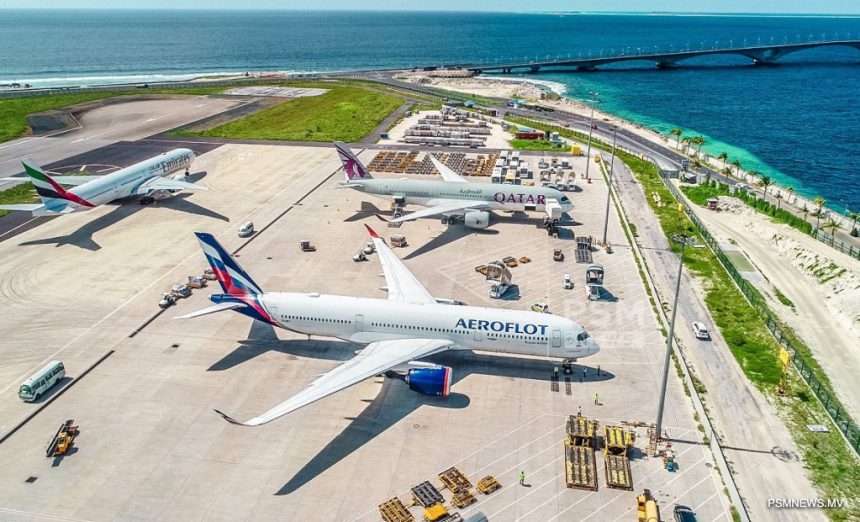
The Maldives has emerged as an unexpected transit point in a global network used to move restricted goods to Russia, according to an investigation published by The Wall Street Journal (WSJ).
The investigation, reported by WSJ journalists Noemie Bisserbe and Thomas Grove, alleges that hundreds of millions of dollars worth of goods restricted by Western sanctions, or ultimately destined for sanctioned Russian companies, have passed through the Maldives.
WSJ said its findings were based on documents it reviewed, including air waybills, a cargo manifest and correspondence between logistics companies, as well as interviews with Western officials.

Some of the goods identified by the newspaper are considered dual-use products, meaning they can have both civilian and military applications.
According to WSJ, aircraft components, electronic equipment and other restricted products have been among cargo moving through Malé.
While the volume is considerably smaller than trade allegedly passing through major sanctions-evasion routes such as China, Turkey and the United Arab Emirates, the newspaper said the Maldives route illustrates the geographical reach of networks established to keep goods flowing into Russia following its invasion of Ukraine.
How the alleged Malé route works
According to the WSJ investigation, Aeroflot, Russia’s largest airline, operates regular services between Moscow and Malé.
The newspaper reported that Russia-linked logistics companies and local intermediaries facilitate the movement of cargo arriving in the Maldives from other countries.
Goods originating from the United States, Europe, China and elsewhere allegedly arrive at Velana International Airport before being transferred to Aeroflot aircraft bound for Moscow.
WSJ reported that the cargo remains within the airport rather than formally entering the Maldivian domestic market.
According to the newspaper, transit cargo generally faces limited physical inspection, with authorities relying heavily on shipping documentation.
The investigation alleges that documentation accompanying some shipments changes while the goods are in Malé.
When cargo initially arrives, the original exporter and supposed buyer can be identified on the air waybill. A new air waybill is then issued for the Malé-Moscow leg, according to documents reviewed by WSJ.
The second document may no longer identify the company that originally sold the products, the newspaper reported.
The goods are subsequently flown to Moscow’s Sheremetyevo International Airport.
WSJ said that once the products reach Russia, some are ultimately distributed to sanctioned Russian entities.
Among those mentioned in the report is S7 Airlines and companies involved in maintaining its aircraft fleet.
Western sanctions have made obtaining replacement aircraft parts and other equipment increasingly difficult for Russian airlines.
Russian data shows dramatic increase in trade
One of the most striking elements of the WSJ investigation is the discrepancy between Maldivian and Russian trade statistics.
According to the newspaper, Maldives Customs data recorded only a very small amount of exports to Russia between 2022 and 2025, including approximately USD 2,300 worth of tuna and USD 25 worth of leaflets and brochures.
Russian trade information collected by US-based research company Import Genius, however, paints a dramatically different picture.
According to figures cited by WSJ, Russian imports recorded as originating from the Maldives surged to more than USD 630 million in 2022.
That compares with less than USD 7 million in 2021.
The dramatic increase coincided with Russia’s full-scale invasion of Ukraine and the subsequent expansion of Western sanctions and export restrictions.
The Maldives has virtually no manufacturing industry capable of producing goods on such a scale, suggesting that much of the trade recorded by Russia involved products transiting through the country rather than goods manufactured locally.
Russian imports recorded from the Maldives stood at approximately USD 160 million in 2024, according to Import Genius data cited by WSJ.
Import Genius Research Director William George told the newspaper that even those figures could underestimate the actual volume.
According to the report, Russian authorities appeared to begin restricting portions of publicly available trade information during 2024 before access was blocked entirely in early 2025.
Microchips, aerospace components and optical equipment
The WSJ investigation identified several categories of products allegedly transported through Malé.
They include microchips, optical instruments and high-strength aerospace fasteners.
Such products can have legitimate civilian applications while also being useful for military equipment.
Microchips, for example, are widely used in consumer and industrial electronics but can also be incorporated into sophisticated weapons and missile guidance systems.
Optical equipment can have civilian applications while also being used in satellite and military surveillance systems.
Specialised aerospace rivets and bolts can similarly be used to maintain commercial aircraft or incorporated into military aircraft and other aerospace systems.
The newspaper’s investigation therefore focuses not only on explicitly military equipment but on the international trade in dual-use technology that Western governments have increasingly attempted to prevent from reaching Russia.
Pavlo Shkurenko, a sanctions research fellow at the Kyiv School of Economics Institute, told WSJ that the findings demonstrated the existence of supply channels well beyond countries traditionally associated with sanctions circumvention.
“This shows there are effective channels that exist far outside of the usual suspects,” Shkurenko told the newspaper.
German shipment allegedly travelled through Malé
WSJ provided a specific example of how the alleged system operates.
In May 2024, German company Kraemer Mining sold equipment worth approximately EUR 9,000, around USD 10,400, to Peretsvo, a company based in Kyrgyzstan.
The shipment reportedly included pumps, batteries, V-belts and other equipment.
According to documents reviewed by WSJ, the goods travelled from Düsseldorf, Germany, to Malé aboard an Emirates flight.
Freight Care, a Maldivian logistics company, was listed as the initial contact for the cargo on the air waybill, according to the report.
Several days after reaching the Maldives, the shipment was allegedly transferred onto an Aeroflot flight bound for Moscow.
WSJ reported that Aeroflot issued another air waybill for this stage of the journey.
The second document allegedly contained no reference to Kraemer Mining or the original source of the products.
Instead, the recipient was identified as Gruppa Kompaniy Tehno, a Russian importer located in Krasnoyarsk, Siberia.
WSJ said Kraemer Mining and Gruppa Kompaniy Tehno did not respond to its requests for comment.
Local companies named by WSJ
The investigation names two Maldivian companies, Freight Care and Go Investment, in connection with handling cargo transiting through Malé.
WSJ reported finding two addresses associated with Freight Care, one appearing on air waybills and another appearing in the Maldives’ official business registry.
Both addresses were reportedly in neighbouring office buildings in Malé, with an Aeroflot office situated between them.
According to WSJ, reporters visiting the two addresses could not find an identifiable Freight Care office.
Freight Care Managing Director Hussain Waheed acknowledged to WSJ that the company handled transit cargo travelling through Malé to Russia.
However, he rejected any suggestion that the company knowingly assisted in transporting materials intended for weapons production.
“We do not support any war,” Waheed told WSJ.
The newspaper also investigated an address associated with Go Investment.
According to the report, the address led journalists to a small electronics shop and was also registered to several other companies in the Maldives business registry.
WSJ reported contacting a man identified as managing director or board member of the companies. The newspaper said he declined to discuss the matter and did not respond to subsequent messages.
Maldives’ economic relationship with Russia
Russia remains an important tourism market for the Maldives.
According to WSJ, Russian tourists represent the second-largest nationality among visitors to the country, behind China.
Tourism is the backbone of the Maldivian economy, making relations with major source markets economically important.
The newspaper suggested this relationship forms part of the wider context surrounding the Maldives’ ties with Russia.
The Maldives’ economy remains heavily dependent on tourism and foreign currency earnings, while the industry is still dealing with financial pressures that intensified during the Covid-19 pandemic.
WSJ also highlighted the financial importance of airport operations.
Maldives Airports Company Limited (MACL), which operates Velana International Airport, became the country’s most profitable state-owned enterprise after recording significant profits in 2024.
MACL generates revenue from airport operations, including cargo handling, commercial charges and aviation fuel.
Cargo volumes at Velana International Airport have also been increasing.
According to figures cited by WSJ, MACL announced in July that the airport had handled a record 126 tonnes of freight in a single day.
Aeroflot accounted for approximately 12 percent of outbound freight during the first half of the year, according to state broadcaster PSM News figures cited in the WSJ report.
Western governments reportedly pressuring Maldives
The United States and European countries have imposed extensive financial sanctions and export restrictions on Russia since Moscow launched its full-scale invasion of Ukraine in February 2022.
Around USD 300 billion in Russian central bank assets have been frozen, while major Russian financial institutions have been cut off from the SWIFT international financial messaging network.
Export controls have also targeted advanced semiconductors, aviation technology, industrial equipment and other products considered important to Russia’s industrial and military capabilities.
As Russia developed alternative supply routes, Western governments increasingly shifted attention toward intermediaries operating in third countries.
Banks, trading companies and logistics providers suspected of facilitating sanctions circumvention have consequently become a growing focus of US and European enforcement efforts.
According to Western officials cited by WSJ, the Maldivian government is facing increasing pressure from the United States and Europe to stop the alleged route through Malé.
A person familiar with the issue told the newspaper that Maldivian authorities are aware of the situation and are working to address it.
One challenge reportedly involves the Maldives Customs Service’s limited resources.
According to the person cited by WSJ, transit cargo generally does not undergo extensive physical inspections, with authorities instead relying primarily on documentation accompanying shipments.
The allegations could place greater attention on the Maldives’ cargo transit system as Western governments intensify efforts to prevent restricted technology and industrial components from reaching Russia through third countries.
The figures cited by WSJ also raise questions over the enormous disparity between exports recorded by Maldivian authorities and imports attributed to the Maldives in Russian trade records.
While the Maldives represents only a fraction of the international trade allegedly being used to bypass Western restrictions, the WSJ investigation portrays the island nation as an unlikely link in a much broader global supply chain that has developed around sanctions imposed on Russia.
Source attribution: This article is based on reporting and documents described in an investigation by The Wall Street Journal, written by Noemie Bisserbe and Thomas Grove. Findings, allegations and statements attributed to WSJ have not been independently verified by The Standard.