

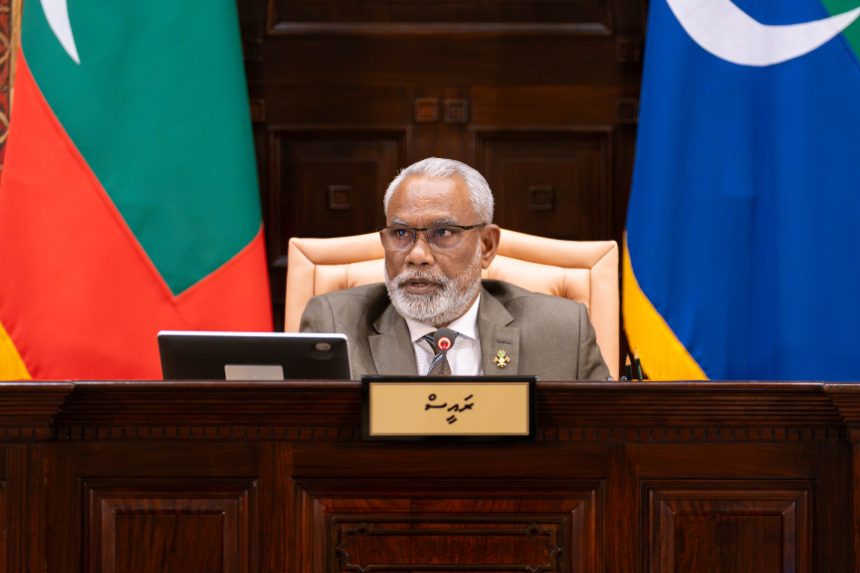
Speaker of the People’s Majlis Abdul Raheem Abdulla has said the Maldives must embrace changing times and pursue modern development, stressing that the country cannot continue operating as it did in the 1960s while future generations aspire to a better standard of living.
The Speaker made the remarks while concluding a parliamentary debate on a resolution submitted by the opposition Maldivian Democratic Party (MDP), seeking the disclosure of further information about the government’s Rasmalé development project.
Addressing lawmakers, Abdul Raheem emphasised that national development requires adapting to changing circumstances and making decisions that reflect the aspirations of the Maldivian people.

“Times have changed. We cannot live today as we lived in the 1960s,” he said, arguing that Maldivians, particularly younger generations, deserve access to the opportunities and living standards enjoyed by people in more developed countries.
He said citizens want to see the Maldives become a developed nation where children can grow up with greater convenience, comfort, happiness and security.
According to the Speaker, achieving these aspirations requires the government to make use of available opportunities to advance the country’s development.
Abdul Raheem said the administration of President Dr Mohamed Muizzu is shaping its policies around these objectives, adding that Parliament has a responsibility to support efforts aimed at delivering progress for the public.
He maintained that lawmakers representing the ruling People’s National Congress (PNC) would fulfil this responsibility throughout the 20th People’s Majlis.
The Speaker also defended the parliamentary majority’s role in determining national affairs, pointing to the mandate received by the PNC during the last parliamentary election.
He said the public had elected a PNC majority to make decisions on matters affecting the country, and that the current Parliament would continue to exercise its responsibilities in accordance with the wishes of the electorate.
Abdul Raheem rejected suggestions that decisions supported by the ruling party’s parliamentary majority should automatically be characterised as decisions made solely to satisfy the government.
He argued that matters presented to Parliament are determined through votes cast by elected representatives, with decisions ultimately reflecting the position of the majority.
As such, he said the opposition MDP could not reasonably portray every decision passed by the parliamentary majority as one made exclusively at the government’s direction.
During his remarks, Abdul Raheem also reflected on what he described as a tendency for people to overlook their own past actions when criticising others for taking similar decisions.
He characterised this behaviour as a common human weakness, suggesting that political criticism should take into account the actions and decisions of previous administrations.
His comments came as Parliament considered the opposition’s resolution concerning Rasmalé, one of the major land reclamation and urban development initiatives being pursued by the Muizzu administration.
The project forms part of the government’s broader plans to expand available land, create new residential and commercial opportunities, and address development pressures in the Greater Malé Region.
Land scarcity and housing demand have remained longstanding challenges in the capital region, where population concentration has placed increasing pressure on residential accommodation, public infrastructure and essential services.
The Rasmalé initiative has consequently become a prominent part of the government’s development agenda, although aspects of its implementation and investment arrangements have attracted scrutiny from opposition lawmakers.
The MDP’s resolution sought greater disclosure of information relating to the project, reflecting concerns raised by the opposition over its arrangements and potential implications.
However, the resolution was rejected following consideration by Parliament, where the ruling PNC holds a substantial majority.
The government has maintained that Rasmalé is intended to support the country’s long-term development and has continued to defend the project against allegations raised by opposition figures.
Among the issues addressed by the administration are concerns surrounding foreign ownership and the possibility of Israeli nationals acquiring property through the development.
Government officials have repeatedly assured the public that Israeli citizens will not be permitted to purchase property through the Rasmalé project.
The administration has also maintained that the ownership of land associated with the development will remain protected and that the project will not compromise the country’s control over the reclaimed territory.
The MDP has questioned aspects of the project, while the government has rejected allegations it considers misleading and continued to provide public assurances regarding the development.
Abdul Raheem’s remarks placed the parliamentary disagreement within a wider discussion about the country’s development priorities and the responsibilities of elected representatives.
He reiterated that the 20th People’s Majlis remains committed to carrying out the mandate entrusted to it by the public, including supporting government initiatives intended to improve living standards and advance national development.
The Speaker maintained that the country’s future should be guided by the needs and aspirations of its people, particularly younger generations seeking opportunities comparable to those available in developed nations.
He said the ruling party’s parliamentary representatives would continue supporting measures they consider necessary to achieve those objectives.