

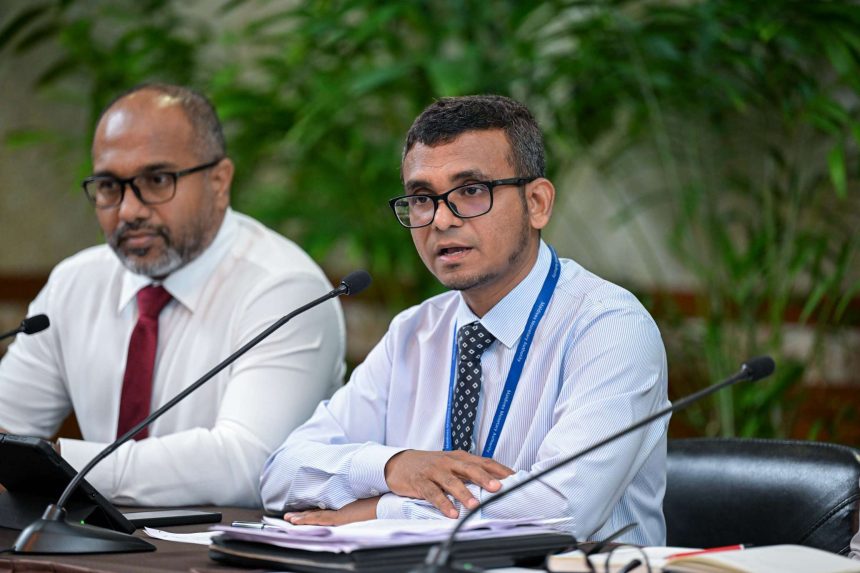
The Maldives Monetary Authority (MMA) aims to make the Maldivian Rufiyaa the primary currency for domestic financial transactions by 2030, Governor Ahmed Munawar has announced, outlining a major shift intended to reduce the economy’s heavy dependence on the US dollar.
Speaking at a press conference at the President’s Office, Munawar said plans are being formulated to achieve the target, noting that more than 40 percent of currency usage in the Maldives currently involves foreign currency.
The Governor said the Maldives should ultimately operate as an economy where domestic transactions are conducted in its national currency, an objective he said has also been shared by previous MMA governors.

Munawar pointed to the aviation and resort industries as examples of sectors where salaries are frequently paid in US dollars.
“Currently, salaries in sectors such as aviation, for instance TMA, and the resort industry are predominantly paid in dollars. Consequently, there must be a shift in the practice of paying salaries in foreign currency. This will effectively increase the demand for Maldivian Rufiyaa,” Munawar said.
He also highlighted tourism land rent, which is currently paid to the government in foreign currency, as another area where the existing practice could be reconsidered.
The Governor said strengthening the Rufiyaa would need to form part of broader macroeconomic reforms, including stabilising government finances.
Munawar also revealed that the MMA’s longer-term vision is for the Maldives to eventually adopt a managed-float exchange rate system. However, he stressed that the central bank would need substantial foreign exchange reserves before such a transition could take place.
As part of the reforms, the Governor said the MMA plans to propose amendments to the Foreign Exchange Act that would raise the mandatory foreign currency conversion requirement for resorts from the current 20 percent to 40 percent.
The MMA also wants the conversion to take place monthly instead of once every three months, while mechanisms would be introduced to monitor how foreign currency income is spent.
The government has separately submitted amendments to the Foreign Exchange Act seeking to abolish the option allowing resorts to convert USD 500 per tourist and replace it with a requirement to convert 20 percent of total revenue.
The bill also seeks to ease requirements for businesses that are 100 percent Maldivian-owned, excluding tourism businesses and financial institutions, by providing greater flexibility where companies encounter difficulties meeting mandatory conversion amounts or deadlines.
Under the proposed amendment, mandatory deposits of foreign currency income into domestic bank accounts would apply to tourism goods and service providers and other entities earning at least USD 25 million in foreign currency during the preceding calendar year. The existing threshold is USD 15 million.
A system already normal in developed and tourism economies
The MMA’s 2030 objective would bring the Maldives closer to the monetary structure found in developed and tourism-dependent economies, where foreign currency earnings are important but the national currency remains the principal unit for domestic economic activity.
New Zealand provides a useful comparison. Tourism is a major export industry, but the New Zealand dollar remains the country’s standard unit of account. The Reserve Bank of New Zealand says contracts are generally denominated in New Zealand dollars and cents, although parties are not legally prohibited from agreeing otherwise.
Iceland is another small island economy with a major tourism industry and extensive exposure to international markets. Its national currency is the Icelandic króna. Foreign currencies can be accepted by businesses, but this does not displace the króna as Iceland’s national currency.
Mauritius offers a comparison closer to the Maldives as an island tourism economy. The Mauritian rupee is legal tender, while banks and licensed foreign exchange dealers maintain an active market for converting foreign currencies, including US dollars, euros, pounds and other major currencies.
The distinction is that a Rufiyaa-based domestic economy would not eliminate the US dollar from the Maldives. Foreign currency would remain crucial for international trade, imports, overseas debt payments and tourism earnings.
Instead, the MMA’s objective is to ensure that foreign currency earned from the outside world does not effectively become a parallel currency for domestic economic activity. If achieved, the 2030 target would place the Rufiyaa more firmly at the centre of salaries, payments and everyday commerce, similar to the role national currencies play in other internationally connected economies.