

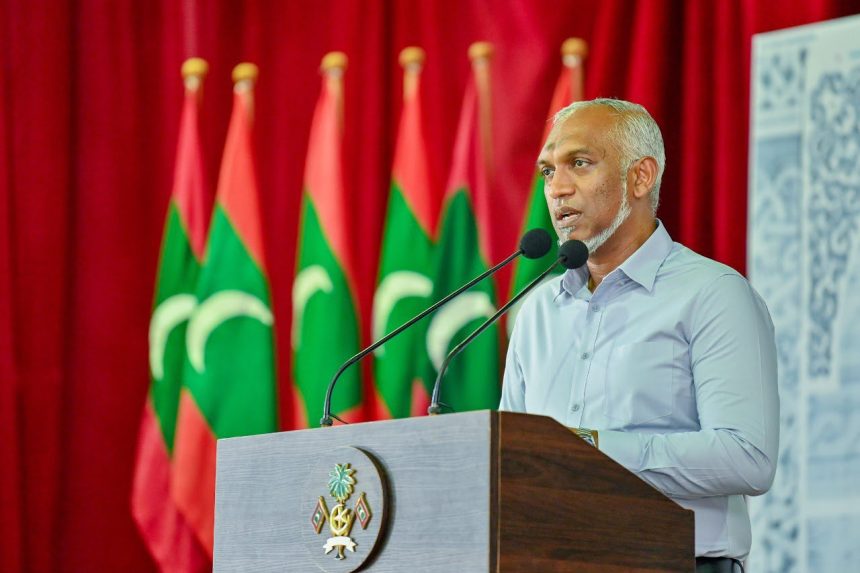
President Dr Mohamed Muizzu has announced plans to restrict property ownership by citizens of any single foreign country to 25 percent of the Ras Malé Waterfront and Marina development, while allowing Maldivians to purchase properties without any nationality-based limit.
The proposed restriction will be introduced through upcoming real estate legislation, which the President said would prevent buyers from any one foreign country from dominating property ownership within the multibillion-dollar development.
Speaking on the President’s Office programme The Pulse, President Muizzu outlined the government’s plans to regulate property sales within the Ras Malé Waterfront and Marina Project, a USD 20 billion development being undertaken in partnership with UAE-based developer Eagle Hills.

The President said the government had decided to establish a maximum ownership threshold for buyers belonging to the same foreign nationality, with the limit set at 25 percent.
Under the proposed arrangement, foreign buyers from any single country would collectively be restricted to purchasing no more than a quarter of the properties covered by the ownership rules.
Maldivian citizens, however, would not be subject to the same restrictions.
President Muizzu said there would be no ceiling on the proportion of properties that Maldivians could acquire, adding that local buyers would theoretically be able to purchase the entire residential offering if sufficient demand existed.
The President also addressed the expected cost of properties within the development, indicating that a residential unit measuring approximately 1,000 square feet could be priced at around USD 600,000, equivalent to approximately MVR 9.25 million.
He expressed confidence that some middle-income and upper-middle-income Maldivians would have the financial capacity to invest in properties at that price.
The remarks provide an indication of the pricing being considered for the development, although detailed property categories, payment arrangements and eligibility requirements have not yet been publicly outlined in the information provided.
The President also announced that Israeli citizens would be prohibited from purchasing, acquiring or residing in properties within the development.
He said the government intended to introduce legal safeguards and verification procedures to prevent Israeli nationals from acquiring property interests in Ras Malé.
According to the President, the restrictions would extend beyond the current project to future developments, with legislation intended to prevent prohibited transactions from taking place.
He said verification mechanisms would be used to examine prospective buyers and ensure that property transactions complied with the proposed restrictions.
The precise legal provisions and enforcement procedures have yet to be published.
The announcements come as the government moves forward with the Ras Malé Waterfront and Marina Project, one of the largest real estate and urban development initiatives proposed in the Maldives.
The government has signed a commercial terms agreement with Eagle Hills, setting out the framework for the development.
The USD 20 billion project is intended to establish a large-scale waterfront destination featuring residential properties, marina facilities and a range of commercial and recreational services.
Plans for the development include entertainment venues, restaurants, retail outlets, wellness facilities, educational institutions, healthcare services and other community amenities.
The project is being presented as an integrated waterfront development combining residential, commercial and leisure facilities within a single master-planned destination.
Ras Malé forms part of the government’s wider efforts to expand urban development and create new opportunities for housing, investment and economic activity in the Greater Malé Region.
The involvement of Eagle Hills, an international property developer headquartered in the United Arab Emirates, reflects the government’s efforts to attract overseas investment into large-scale infrastructure and real estate projects.
However, the proposed ownership framework indicates that foreign investment in the development would be subject to nationality-based restrictions rather than allowing unrestricted purchases by overseas buyers.
The distinction between foreign and Maldivian ownership is particularly significant given the scale of the project and the potential involvement of international property investors.
While the government has indicated that Maldivians will have unrestricted access to purchasing properties, the President’s indicative price of USD 600,000 for a 1,000-square-foot unit also raises questions about affordability for prospective local buyers.
The proposed restrictions will require a legal framework defining how ownership limits are calculated, how nationality is verified and how compliance is maintained when properties are subsequently resold or transferred.
The government has not yet disclosed whether the 25 percent ceiling will apply to the total number of properties, their aggregate value or another measure of ownership.
Further details are expected to emerge when the proposed real estate legislation is introduced.
For now, the President’s announcement establishes the government’s intended approach to property ownership in Ras Malé, with foreign nationality limits, unrestricted Maldivian participation and specific prohibitions forming part of the planned regulatory framework.