

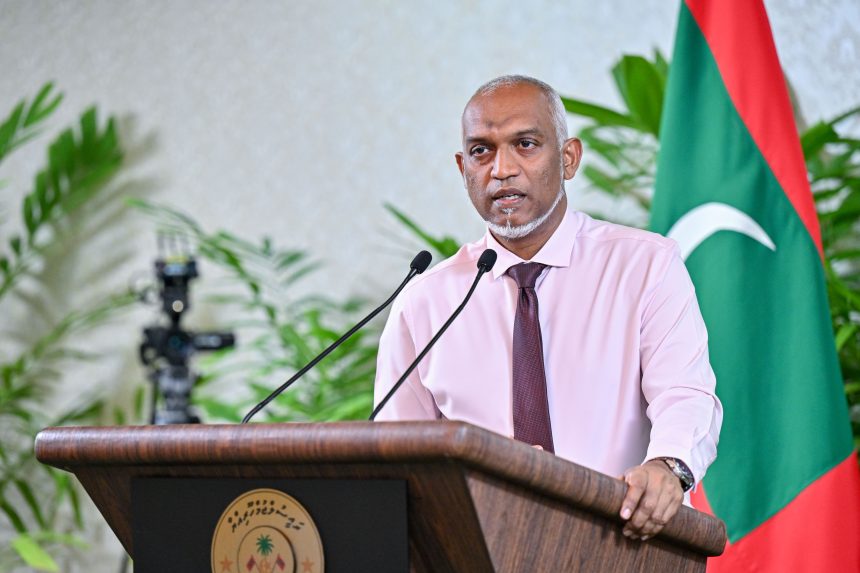
President Dr. Mohamed Muizzu has announced plans to introduce restrictions on social media use for children under the age of 16, citing growing concerns over cyberbullying, online grooming and exposure to harmful content.
Speaking at a press conference held at the President’s Office, the President said the government has already begun work on measures aimed at protecting young people from the risks associated with social media platforms.
According to President Muizzu, the issue is not unique to the Maldives and has become a global concern as children increasingly spend more time online.

“Our youngest children are being exposed to highly negative influences on social media. Cyberbullying, online grooming and access to harmful content have become serious challenges worldwide,” the President said.
He stressed that safeguarding children from such dangers is a responsibility shared by the government, families, educational institutions and society as a whole.
As part of the initiative, the government plans to consult a wide range of stakeholders, including regulatory authorities, civil society organizations, non-governmental groups and members of the public before introducing legislative changes.
The President said the goal is to amend relevant laws and establish a framework that would limit access to certain social media applications for individuals below the age of 16.
The proposal comes as several countries around the world explore stricter controls on children’s use of social media. President Muizzu specifically pointed to Australia’s recent move to introduce age-based restrictions, describing it as a positive example that the Maldives could learn from.
He said discussions would also be held with social media companies as part of efforts to implement age-based access controls.
According to the President, practical work on the initiative is expected to begin within the next year, with the possibility of implementation taking place even sooner.
While outlining the proposal, President Muizzu emphasized that the move should not be viewed as a step away from digital transformation.
He reiterated that the government’s broader vision remains focused on building “Maldives 2.0” and transforming the country into an AI-driven digital society.
“The internet remains essential for education, learning and acquiring new skills,” he said, adding that the intention is not to limit constructive use of digital technologies but rather to protect young users from harmful online environments.
The announcement follows growing international debate over the impact of social media on children’s mental health and wellbeing. Governments, regulators and technology companies around the world have faced increasing pressure to address issues such as cyberbullying, online exploitation, addictive platform design and exposure to inappropriate content.
In the Maldives, concerns about online safety have also been raised in recent years by educators, parents and child protection advocates, particularly as internet access and smartphone usage continue to expand among younger age groups.
If implemented, the proposed restrictions would mark one of the most significant digital safety reforms undertaken in the Maldives and place the country among a growing number of nations introducing stricter safeguards for children online.