

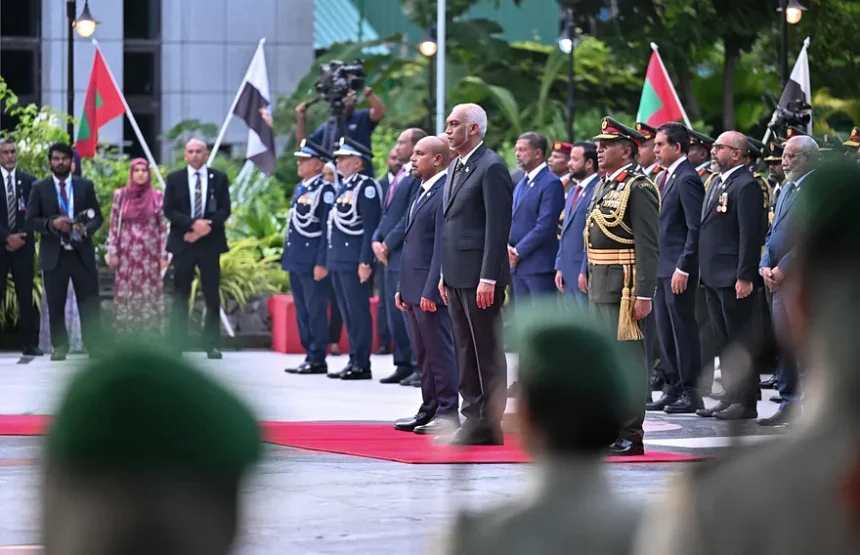
President Dr Mohamed Muizzu has called on Maldivians to reflect on the courage and sacrifices of the country’s armed forces during the 1988 attempted coup, stressing the importance of learning from the events of Victory Day to safeguard the nation’s independence.
His message comes as the Maldives marks the 38th anniversary of the 3 November attack, which claimed the lives of 19 Maldivians and remains one of the most significant events in the country’s modern history.
The annual commemorations began on Tuesday morning with a congregational Fajr prayer at the Islamic Centre in Malé, marking the start of official Victory Day activities.

Victory Day commemorates the defeat of an armed attempt to overthrow the government of then-President Maumoon Abdul Gayoom on 3 November 1988.
The attack was carried out by militants from the Sri Lankan Tamil organisation People’s Liberation Organisation of Tamil Eelam (PLOTE), working alongside Maldivian conspirators seeking to remove Gayoom from power.
Armed militants arrived in Malé and launched an assault on key locations in the capital, leading to confrontations with Maldivian security personnel who resisted the attempted takeover.
Eight members of the armed forces and 11 civilians lost their lives during the attack, bringing the total number of Maldivian fatalities to 19.
The resistance mounted by Maldivian soldiers played a central role in preventing the attackers from securing complete control of the capital.
India subsequently launched a military intervention known as Operation Cactus, deploying troops to assist the Maldives in defeating the attempted coup and restoring security.
As the operation failed, the surviving militants attempted to escape aboard the cargo vessel Progress Light, which had been docked at Malé harbour.
The fleeing group took Maldivian hostages aboard the vessel, but Indian military forces pursued and intercepted it at sea.
The vessel was attacked and sank during the confrontation, with Indian forces rescuing most of the Maldivian hostages.
Abdulla Luthufee and Sagar Ahmed Nasir, who were identified as leading figures behind the attempted coup, were subsequently captured along with surviving members of the attacking group and brought back to Malé.
The two men were prosecuted for their involvement in the attack and sentenced to death by the High Court, which was the country’s highest judicial authority at the time.
However, President Gayoom later exercised his constitutional powers to commute their death sentences to life imprisonment.
The events of 3 November have since been commemorated annually as Victory Day, with ceremonies honouring the service personnel and civilians who lost their lives defending the country.
The occasion also serves as a reminder of the threats faced by the Maldives during the attempted coup and the role played by the armed forces in protecting the country’s sovereignty.
Official commemorations traditionally include special prayers, flag-hoisting ceremonies, military displays and gatherings at the Victory Day Memorial in Malé.
This year’s activities are being held in remembrance of those who died in the attack, while recognising the sacrifices made to preserve the Maldives’ independence.