

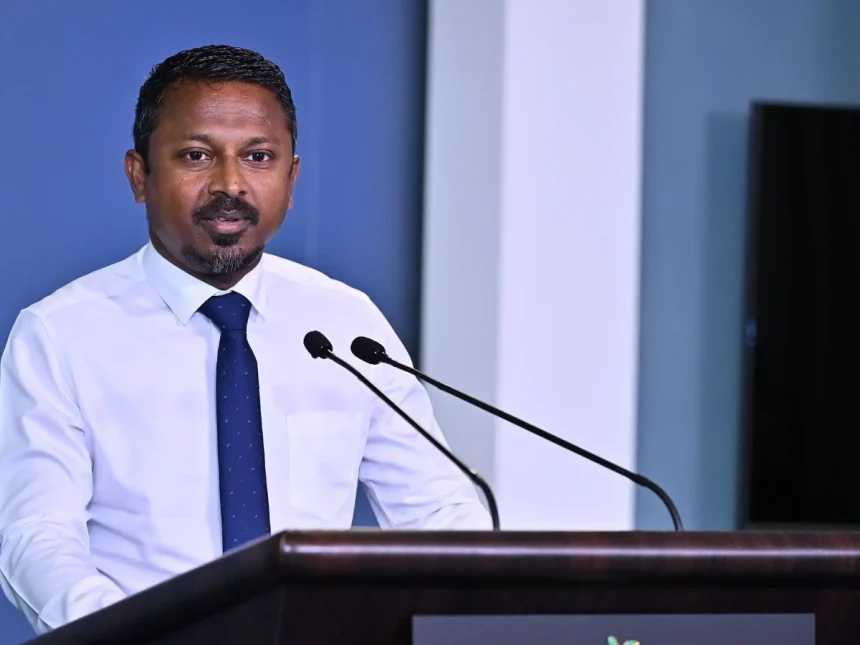
Attorney General Ahmed Usham has assured that the government will not take any steps that violate the Constitution or Maldivian law in implementing the proposed USD 20 billion waterfront and marina development in Ras Malé.
Usham made the remarks while responding to concerns and claims raised over the legal framework of the project, which the government plans to develop in partnership with Abu Dhabi-based developer Eagle Hills.
In a post on X, the Attorney General said the agreement signed so far is a Letter of Intent setting out the principal commercial terms of the proposed development. Definitive agreements have yet to be signed, and further negotiations and legislation will be required before the project proceeds.

The government and Eagle Hills signed the commercial terms agreement earlier this month for the Maldives Waterfront and Marina, a large integrated development planned for Ras Malé. The project is envisioned at around USD 20 billion across its various phases, rather than as an upfront USD 20 billion investment.
Plans for the development include international hotels and resorts, premium and branded residences and a large marina, alongside retail, dining, entertainment, wellness, education, healthcare and other community facilities.
Addressing questions surrounding long-term rights associated with the development, Usham pointed to changes made to resort lease periods under previous administrations.
He said the Maldives’ first Tourism Act, enacted in 1999, allowed tourist resorts to be leased for a maximum of 25 years. That period was extended to 50 years through an amendment in 2010 during former President Mohamed Nasheed’s administration, before being increased to 99 years in 2015 under former President Abdulla Yameen Abdul Gayoom.
Usham made the comparison while responding to criticism from the opposition, noting that the 99-year resort lease period itself had been introduced during Yameen’s presidency.
He also referred to provisions in Section 8 of the Tourism Act, saying that when a 99-year resort lease expires, the state is required to compensate the investor for the remaining value of the investment after depreciation is taken into account.
However, Usham said the proposed Ras Malé development would not simply proceed under the existing resort framework. Instead, the government is preparing a Real Estate Bill that would provide the legal framework for the development.
Further discussions will be held with Eagle Hills based on the commercial terms already agreed before definitive agreements are signed, he said. The necessary legislation would also have to be passed by Parliament.
Usham reiterated that the government would not enter into arrangements that contravene the Constitution or existing laws as the project moves through those stages.
President Dr Mohamed Muizzu has separately given similar assurances, saying the project would operate through leasing arrangements rather than the sale of Maldivian land. He has also said the government would not provide sovereign guarantees, government loans, tax concessions or duty exemptions for the development.
The proposed development represents a major new component of the government’s wider plans for Ras Malé, the new city being created through the reclamation of Fushi Dhiggaru Lagoon.
A total of 1,150 hectares is planned to be reclaimed for Ras Malé, with 716 hectares completed so far, according to figures provided by the government. Plans for the new city include around 65,000 housing units through a combination of flats and land plots, including 15,000 plots intended for residents of Malé.
The Eagle Hills development is intended to add a major tourism, residential and commercial component to the new city. Preliminary projections released alongside the agreement estimate that the project could attract more than USD 30 billion in gross foreign investment over its lifetime and support economic activity across construction, tourism, retail, marine services and technology.
Eagle Hills is chaired by UAE businessman Mohamed Alabbar, who also founded Emaar Properties, the developer behind major projects including the Burj Khalifa and Dubai Mall. Eagle Hills itself has undertaken large waterfront and mixed-use developments in several international markets.