

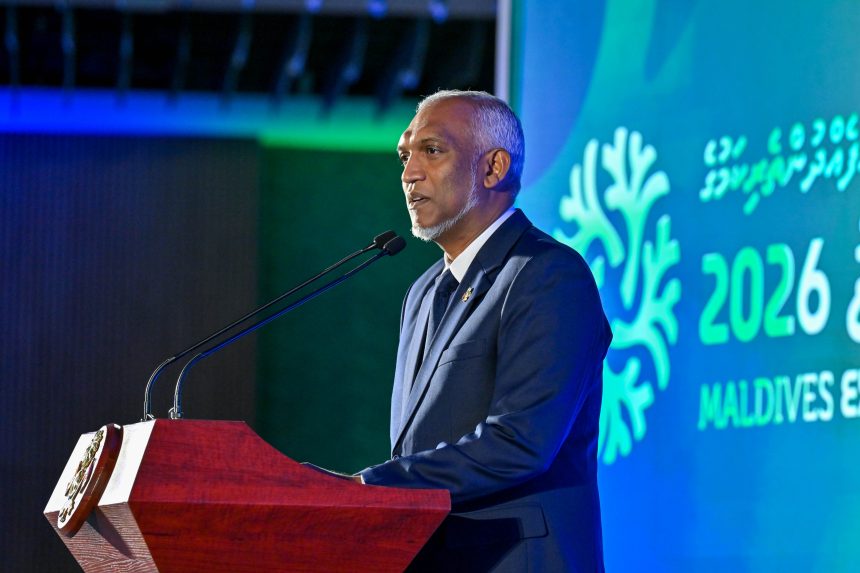
President Dr Mohamed Muizzu has announced a five-year exemption from import duties on raw materials used by micro, small and medium enterprises (MSMEs), as part of a series of measures aimed at reducing business costs, expanding access to financing and easing tax obligations for Maldivian entrepreneurs.
The exemption, scheduled to take effect on January 1, 2027, will introduce a zero percent import duty rate on designated materials used in manufacturing and production by eligible small businesses.
Speaking at the Maldivian Production Expo 2026 awards ceremony at Barceló Nasandhura on Saturday evening, President Muizzu said the government had decided to prepare a comprehensive list of raw materials that would qualify for the exemption.

The measure is intended to reduce production costs for local businesses that depend on imported materials, particularly those involved in manufacturing and other productive activities.
The President said the decision forms part of the administration’s broader efforts to strengthen the MSME sector by addressing financial and administrative challenges faced by entrepreneurs.
He highlighted several initiatives introduced over the past year, including expanded financing opportunities, reductions in certain business-related fees and measures designed to make it easier for smaller enterprises to operate.
President Muizzu said he had personally engaged with business operators to understand the difficulties they face, with several government decisions subsequently introduced to address their concerns.
Among the issues raised was the financial burden associated with annual quota fees, which the President said had placed considerable pressure on micro and small businesses.
To address the problem, the government has introduced concessions covering annual fees for up to 20 quotas, alongside other measures intended to reduce operating expenses.
The President also highlighted progress in expanding access to financing, announcing that MVR 795 million in loans had been disbursed to more than 1,000 entrepreneurs through Bank of Maldives (BML) and SME Digital during 2026.
He said the financing had supported businesses operating across the MSME sector, reflecting the government’s efforts to make funding more accessible to smaller enterprises.
In addition, the President provided an update on a specialised financing programme introduced in July to support young entrepreneurs seeking to establish or expand businesses.
According to the figures announced, more than MVR 300 million in loans had been allocated to over 3,000 young people following the completion of the programme’s first phase.
President Muizzu confirmed that the second phase would begin on November 1, with the overall initiative targeting the disbursement of up to MVR 1 billion in loans.
The programme is intended to support young Maldivians entering the business sector by providing financing for new ventures and the expansion of existing enterprises.
Access to affordable financing remains an important consideration for smaller businesses, particularly those seeking to purchase equipment, increase production capacity or establish operations without substantial initial capital.
The President also announced a new mechanism to address tax payment difficulties faced by MSMEs that are awaiting payments from the government.
He acknowledged that delays in settling payments owed to contractors undertaking state-funded projects had created financial challenges for some businesses, particularly when they were simultaneously required to meet tax obligations.
Under the proposed arrangement, outstanding payments owed by the government to eligible businesses will be offset against the taxes those businesses owe to the state.
President Muizzu explained that the mechanism would allow the two amounts to be settled on a net basis, reducing the immediate financial burden on affected enterprises.
For example, if a business is owed MVR 100,000 by the government but has a tax liability of MVR 60,000, the tax obligation would be offset against the outstanding government payment, leaving MVR 40,000 payable to the business.
Similarly, if a company owes MVR 100,000 in taxes while the government owes it MVR 60,000, the business would only be required to settle the remaining MVR 40,000.
The President said businesses whose outstanding government receivables exceed their tax liabilities would not be required to make an additional tax payment against those liabilities.
The arrangement is intended to provide relief to businesses experiencing cash flow difficulties because of delayed government payments, while allowing outstanding tax obligations to be reconciled.
Another significant change announced by the President concerns the Goods and Services Tax (GST) registration threshold.
From January 1, 2027, the annual turnover threshold for mandatory GST registration is planned to increase from MVR 1 million to MVR 1.5 million.
The President said the necessary legislative amendments would be submitted shortly to give effect to the change.
The proposed increase would mean businesses with annual taxable turnover below the new threshold would generally no longer be required to register for GST solely on the basis of exceeding the existing MVR 1 million threshold, subject to the applicable legal requirements.
The measure is intended to reduce administrative and compliance obligations for smaller enterprises, particularly those operating with relatively modest annual revenues.
For businesses approaching the existing threshold, GST registration can introduce additional responsibilities involving tax reporting, recordkeeping and compliance.
Raising the threshold could therefore reduce regulatory costs for some smaller operators while allowing them to focus more resources on business development.
The planned import duty exemption represents another component of the government’s efforts to encourage domestic production and reduce the cost of operating manufacturing businesses in the Maldives.
As an import-dependent economy, the Maldives relies heavily on overseas suppliers for raw materials, equipment and other inputs required by local businesses.
Import duties can add to the cost of production, particularly for smaller manufacturers that lack the purchasing capacity and financial resources available to larger companies.
Reducing duties on eligible production materials could help lower these costs and improve the competitiveness of locally manufactured goods.
However, the specific materials that will qualify for the exemption have yet to be announced, with the government expected to finalise the relevant list before the measure takes effect.
The President said the combined initiatives reflect the administration’s commitment to developing a more supportive business environment and encouraging greater participation in productive economic activities.
The announcements come as the government continues to promote entrepreneurship, domestic production and economic diversification, with particular emphasis on expanding opportunities for small businesses and young Maldivians.
President Muizzu expressed confidence that the financing programmes, tax measures and import duty exemptions would help reduce barriers faced by entrepreneurs and create greater opportunities for business growth.
With several measures scheduled to take effect from November 2026 and January 2027, the government is preparing to introduce changes intended to improve access to capital, ease financial obligations and support the development of local enterprises.