

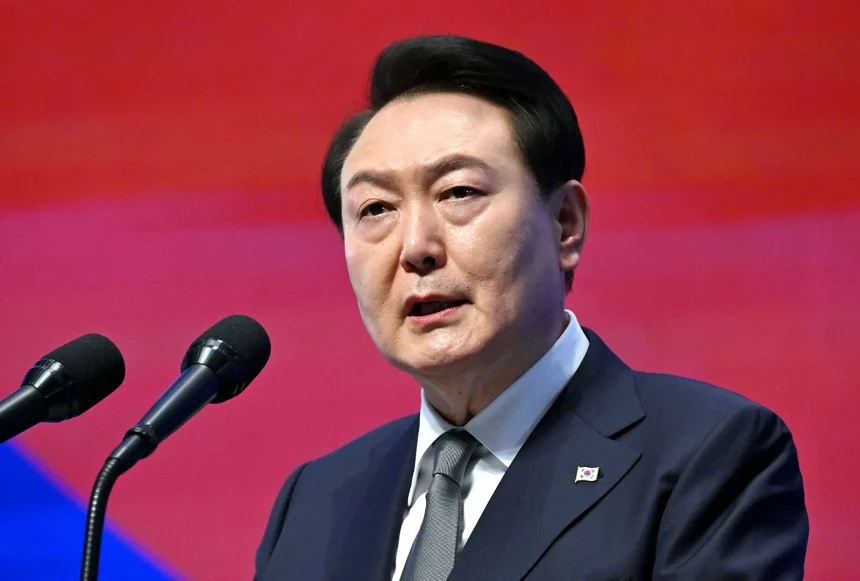
South Korean prosecutors have formally called for the death penalty against former president Yoon Suk Yeol, accusing him of leading an attempted insurrection through his failed declaration of martial law in December 2024.
The demand was made during closing arguments at the Seoul Central District Court, marking the first insurrection trial of a former South Korean head of state in nearly 30 years. Prosecutors described the case as an unprecedented assault on the country’s constitutional framework, arguing that Yoon’s actions posed a direct threat to national security and public freedom.
Under South Korean criminal law, the charge of leading an insurrection carries only three possible punishments: death, life imprisonment with labour, or life imprisonment without labour. The court is expected to deliver its verdict on February 19.

Prosecutors told the court that Yoon deliberately ordered troops into the National Assembly on the night of December 3, 2024, allegedly instructing them to block lawmakers from voting to overturn the martial law decree. The crisis lasted around six hours, ending when 190 lawmakers forced their way past military lines to pass an emergency resolution, compelling Yoon to withdraw the order.
Parliament subsequently impeached Yoon on December 14, and the Constitutional Court removed him from office in April 2025. A snap election later brought opposition leader Lee Jae Myung to the presidency.
In their submissions, prosecutors said Yoon began planning the operation before October 2023, with the alleged aim of consolidating power through prolonged rule. They claimed military officials loyal to Yoon were strategically positioned ahead of the declaration, and that preparations were recorded in notebooks and mobile phone memos.
According to prosecutors, the plans went as far as outlining the detention and torture of election officials to extract false confessions of electoral fraud, as well as cutting electricity and water supplies to major media outlets to silence coverage.
They also sought life imprisonment with labour for former defence minister Kim Yong-hyun, describing him as having acted in complete coordination with Yoon throughout the plot.
A lack of remorse was cited as a major aggravating factor. Prosecutors told the court that Yoon has never issued a genuine apology, instead placing blame on the then-opposition while continuing to inflame supporters. Some of those supporters later stormed a courthouse in violent protests following his arrest.
Yoon, himself a former prosecutor general, was fully aware that the martial law declaration violated constitutional limits, prosecutors argued.
In a brief statement, the presidential office said it expected the judiciary to reach a decision based on law, principle, and public expectations.
The case echoes South Korea’s 1996 trials of former military rulers Chun Doo-hwan and Roh Tae-woo, who were convicted over their roles in the 1979 coup and the Gwangju massacre. While both initially received harsh sentences—including a death sentence later reduced—they were eventually pardoned.
South Korea has not carried out an execution since 1997 and is considered a de facto abolitionist state by international human rights organisations, despite retaining capital punishment in law.