

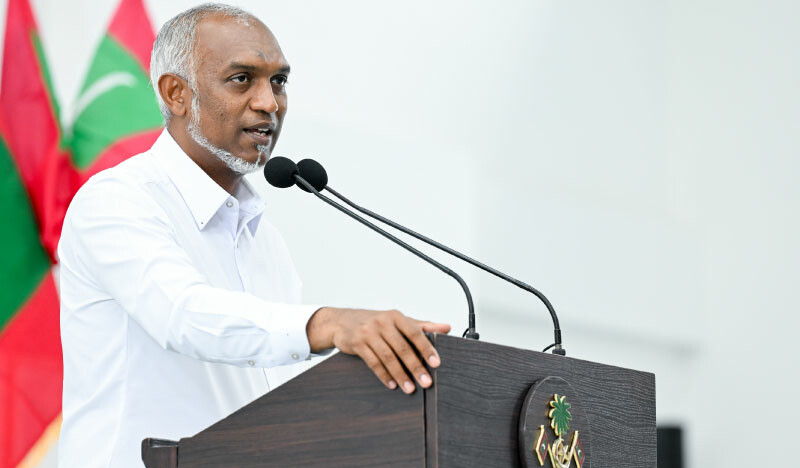
President Dr. Mohamed Muizzu has reaffirmed the government’s commitment to strengthening food safety standards in the Maldives, assuring that efforts will continue to ensure food available to the public remains safe, healthy and reliable.
The President made the remarks in a message shared on social media to mark World Food Safety Day, observed globally on June 7.
In his message, Muizzu highlighted the importance of food safety in protecting public health, preventing disease and supporting broader sustainable development goals.

He noted that many illnesses linked to contaminated food can be prevented through effective regulatory systems, scientific research, data-driven policies and the collective efforts of institutions and communities.
“The government will continue its efforts to ensure that the food consumed in the Maldives is safe, healthy and trustworthy,” the President said.
As part of those efforts, he pointed to ongoing work to strengthen the country’s food safety framework, including plans to introduce a Food Safety Act and expand systems for monitoring, testing and regulating food products entering the local market.
The Maldives relies heavily on imported food products, making food safety monitoring a critical component of public health protection. Authorities have in recent years increased efforts to improve inspection procedures and strengthen oversight mechanisms for imported food items.
The President said the administration is working to establish stronger systems capable of monitoring food quality while ensuring imported products meet required safety standards before reaching consumers.
On this #WorldFoodSafetyDay, we are reminded of the significance of safe food in eliminating foodborne diseases, protecting public health, and sustainable development. Most of the foodborne illnesses are preventable through stronger systems relying on data driven action,… pic.twitter.com/zbFF6KDwoZ
— Dr Mohamed Muizzu (@MMuizzu) June 7, 2026
World Food Safety Day was established by the United Nations to raise awareness of food-related health risks and promote actions that help prevent foodborne diseases. According to international health agencies, unsafe food remains a major public health challenge globally.
Statistics published by the World Health Organization (WHO) and the Food and Agriculture Organization (FAO) indicate that nearly 800 million people suffer from food-related illnesses each year, while approximately 1.5 million deaths are linked to contaminated food annually.
This year’s World Food Safety Day theme, “Food Safety: Science in Action,” emphasizes the role of scientific knowledge and evidence-based decision-making in reducing foodborne risks and improving public health outcomes worldwide.
In addition to highlighting domestic food safety efforts, the President also used the occasion to draw attention to humanitarian crises affecting communities in different parts of the world.
He expressed concern for people living in conflict-affected regions, particularly those facing shortages of safe food and clean drinking water, including civilians in Gaza.
Muizzu called on the international community to work together to address food insecurity and improve access to safe food and water for vulnerable populations.
He stressed that achieving a safer future requires strong partnerships, effective regulations and a shared commitment to maintaining high standards across food production and supply chains.
The President’s remarks come as the Maldives continues efforts to modernize its food safety systems and strengthen public health safeguards amid growing global attention on food security, food quality and consumer protection.