

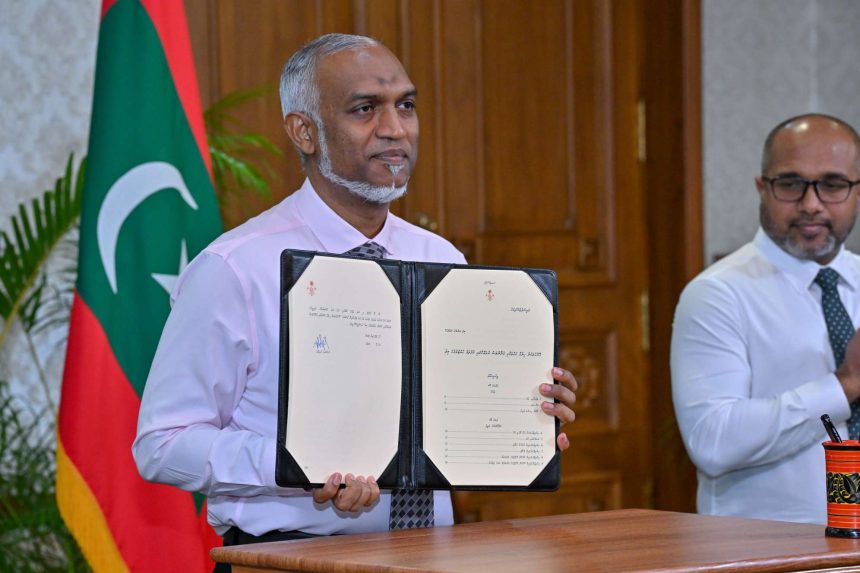
The government has submitted an Asset Recovery Bill to the People’s Majlis, seeking sweeping legal powers to recover property and wealth obtained through serious criminal activity and prevent offenders from continuing to profit from crime.
President Dr Mohamed Muizzu announced the submission on Tuesday, saying a central objective of the legislation is to establish a comprehensive framework for forfeiting illicitly acquired assets.
The proposed law is also intended to address longstanding legal obstacles faced by the state in recovering public assets and property obtained unlawfully through criminal acts.

The move comes as international assessments have highlighted significant weaknesses in the Maldives’ existing asset recovery system.
The Asia/Pacific Group on Money Laundering’s 2025 evaluation of the Maldives found that asset seizure and confiscation were not sufficiently prioritised by authorities and that the country lacked a comprehensive national asset recovery strategy. The assessment also found that investigative agencies did not have dedicated procedures for tracing, targeting, seizing and confiscating criminal assets.
The Anti-Corruption Commission has separately acknowledged the legal gap. A study conducted by the commission in 2022 concluded that the Maldives did not have a structured legal framework specifically designed for recovering proceeds of crime.
The ACC subsequently worked on a model asset recovery law incorporating mechanisms including confiscation following a criminal conviction, confiscation without a criminal conviction and administrative confiscation by the state.
President Muizzu has repeatedly identified asset recovery as a key pillar of his administration’s anti-corruption agenda.
In his 2025 Presidential Address, the President said an Asset Recovery Bill was being developed to facilitate the recovery of illegally obtained assets and address situations where state property had been acquired at unfairly low valuations.
Later that year, Muizzu said government agencies would actively pursue individuals implicated in major theft and corruption cases once the legislation came into force. He said the law was necessary because authorities had historically faced difficulties recovering money and assets linked to major corruption investigations.
The President has also linked the legislation with wider reforms to the Anti-Corruption Act, Penal Code, Criminal Procedure Code and Evidence Act as part of efforts to strengthen the country’s ability to investigate and prosecute corruption and illicit enrichment.
If approved by Parliament and ratified, the Asset Recovery Bill could therefore mark a major shift in the Maldives’ approach to serious financial crime, moving beyond prosecuting offenders towards systematically tracing, freezing and recovering the economic proceeds of criminal activity.