

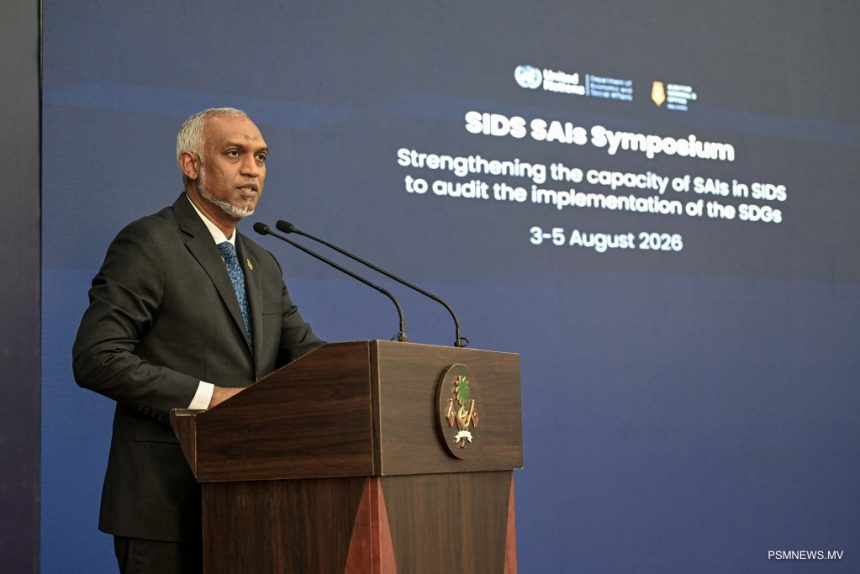
President Dr. Mohamed Muizzu has called for stronger integrity, greater accountability and transparent governance, saying these principles are essential to building resilient nations capable of meeting future challenges.
The President made the remarks while addressing the closing ceremony of the Small Island Developing States Supreme Audit Institutions (SIDS-SAI) Symposium and the opening of the INTOSAI Development Initiative (IDI) Global Summit, held in AA. Ukulhas.
In his address, President Muizzu said countries seeking to build stronger democracies, sustainable economies and prosperous communities must work collectively to reinforce good governance and public trust.

He stressed that resilience extends beyond physical infrastructure, arguing that strong institutions and responsible financial management form the foundation of a nation’s long-term stability.
“Our ability to withstand future challenges is not measured solely by the sea walls we build or the infrastructure we develop,” the President said. “True resilience is built on strong institutions, responsible financial management, transparency and the trust people place in their governments.”
Highlighting the role of Supreme Audit Institutions (SAIs), President Muizzu said independent oversight bodies play a vital role in ensuring public resources are managed responsibly and that governments remain accountable to citizens.
He said every dollar collected from taxpayers, as well as every contribution received from international development partners, must be used for its intended purpose, describing accountability as more than an administrative obligation.
“Accountability is a strategic national asset and a driver of progress,” he said.
The President also reflected on the unique realities facing Small Island Developing States (SIDS), noting that many continue to balance debt management with long-term investment, respond to emergencies while pursuing sustainable development, and protect vulnerable communities amid economic and environmental pressures.
Despite growing global uncertainty and external economic challenges, he said the Maldives has continued to meet its financial commitments while investing in the country’s future development.
President Muizzu also highlighted the opportunities presented by digital transformation, particularly for geographically dispersed island nations.
He said the government’s Maldives 2.0 initiative is aimed at building a modern, citizen-focused digital state, adding that technology should be viewed not only as a tool for innovation but also as an essential component of effective governance, service delivery and national resilience.
During the ceremony, the President officially launched the Auditor General’s Office Strategic Plan 2026–2029, which will guide the institution’s priorities over the coming four years.
The symposium, hosted in Ukulhas, brought together representatives of Supreme Audit Institutions from Small Island Developing States to exchange expertise, strengthen institutional capacity and discuss the role of public auditing in advancing the United Nations Sustainable Development Goals (SDGs).
Recognised for its environmental initiatives and commitment to sustainable island management, Ukulhas served as the venue for discussions focused on strengthening governance and accountability among island nations facing shared development challenges.