

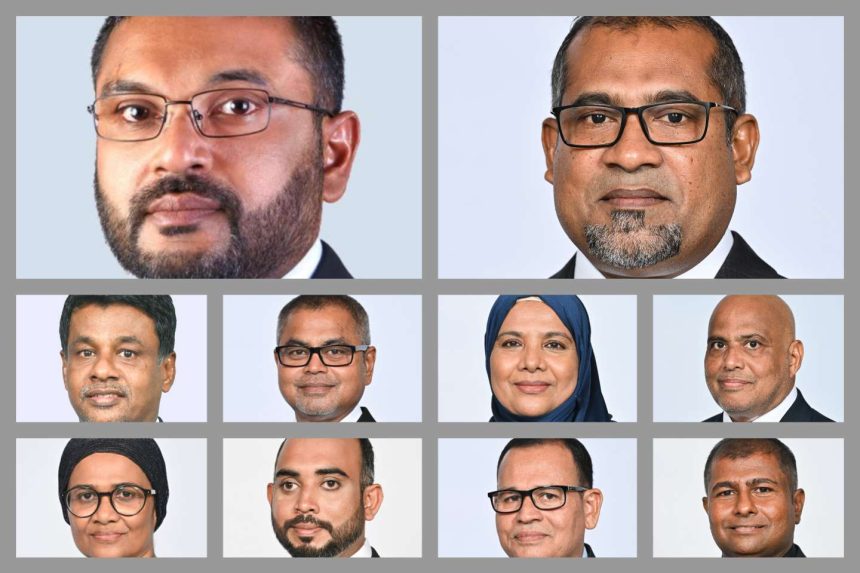
A major political reset is underway in the Maldives after President Dr Mohamed Muizzu accepted the resignation of ten Cabinet Ministers on Tuesday, signaling the start of a new phase in the administration’s reform agenda.
According to an official statement from the President’s Office, the coordinated resignations were intended to enable “positive transformations” within the government and better align state policy with public expectations. The move represents one of the most extensive cabinet overhauls in recent years, affecting half of the country’s top ministerial posts.
The President acknowledged the contributions of the outgoing ministers, expressing appreciation for their service during a critical period of governance.

Those who stepped down include:
- Mohamed Ghassan Maumoon, Minister of Defence
- Dr. Abdulla Khaleel, Minister of Foreign Affairs
- Abdulla Nazim Ibrahim, Minister of Health
- Thoriq Ibrahim, Minister of Tourism and Environment
- Dr. Aishath Shiham, Minister of Social and Family Development
- Adam Nassir Ibrahim, Minister of Dhivehi Language, Culture and Heritage
- Dr. Maryam Mariya, Minister of Agriculture and Animal Welfare
- Ibrahim Waheed, Minister of Youth Empowerment, Information and Arts
- Adam Shareef Umar, Minister of Cities, Local Government and Public Works
- Dr. Ali Haidar Ahmed, Minister of Higher Education, Labour and Skills Development
The restructuring comes at a politically sensitive moment, following recent electoral outcomes that intensified scrutiny on government performance and delivery. The administration had earlier hinted at internal changes, with President Muizzu emphasizing the need for a more responsive and results-driven governance model.
Analysts view the mass resignation as a calculated reset rather than a crisis, aimed at consolidating leadership, streamlining decision-making, and accelerating priority projects across sectors such as housing, infrastructure, and public services.
The shake-up also follows a string of leadership changes across state-owned enterprises, pointing to a broader effort to recalibrate both political and administrative arms of government.
Attention now turns to the President’s next moves, with expectations of a refreshed cabinet lineup designed to reinforce policy execution and restore political momentum in the months ahead.