

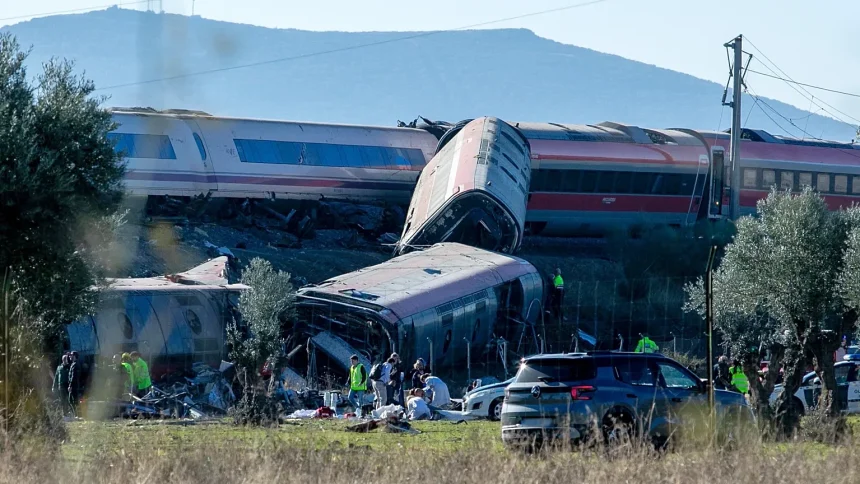
At least 30 people have been killed after two high-speed passenger trains collided in central Spain on Wednesday, causing carriages to derail and leaving wreckage scattered along a railway embankment.
The collision occurred in Toledo province on the railway connecting Madrid and Seville, involving trains operated by Spain’s state-owned rail company Renfe and private operator Iryo.
Authorities in the Castilla-La Mancha region confirmed that the death toll had risen sharply from an initial figure of 10 to at least 30, as emergency teams continued responding to the disaster.

According to regional government spokesperson Esther Padilla, both trains were travelling in the same direction from Madrid towards Seville when one struck the rear of the other, which had stopped on the tracks.
The impact forced two carriages of the stationary train off the rails. The circumstances that caused the first train to stop and the subsequent collision remain under investigation.
Spanish media reported that the Renfe train appeared to have struck the Iryo service from behind.
Television footage from regional broadcaster CMM showed the extent of the destruction, with a derailed train partially stranded on an elevated section of railway.
At least one carriage remained on the raised track, while damaged metal panels and other debris were scattered down the embankment.
Passengers described a violent impact as the trains collided.
One survivor, identified as Miguel, told Spanish radio station Cope that he had been travelling in a rear carriage with several colleagues when they heard an enormous crash lasting several seconds.
He said the noise was so intense that passengers feared their train was about to derail. Looking through a window, he could see what appeared to be the wreckage of the other train.
Hundreds of passengers were reportedly aboard the two services at the time of the collision.
Emergency services were deployed to the scene to assist passengers and coordinate the response, while nearby communities prepared facilities to accommodate those affected.
Manuel Galán, mayor of Urda, a municipality near Toledo, said emergency authorities had requested that a local sports hall be made available to receive injured passengers.
The disaster has raised fresh concerns about railway safety in Spain, coming months after another deadly collision near Adamuz in January 2026 that claimed 46 lives.
That accident also involved trains operated by Renfe and Iryo, making Wednesday’s collision another major tragedy involving the country’s high-speed rail network.
Government sources cited by Spanish newspaper El País expressed concern that the latest disaster could prove even more severe than the Adamuz crash.
The collision has also disrupted political activities across Spain, where parties are preparing for a general election scheduled for next month.
Major political parties suspended their planned engagements for Wednesday as the scale of the tragedy became clear.
Prime Minister Pedro Sánchez expressed shock over the incident and said he was maintaining direct communication with the transport minister and the president of Castilla-La Mancha.
He confirmed that emergency personnel were working at the scene, with national and regional authorities coordinating assistance for those affected.
Sánchez also conveyed his condolences and support to the victims and their families.
Opposition People’s Party leader Alberto Núñez Feijóo expressed concern over the latest railway disaster, stressing that immediate attention should be directed towards helping victims and supporting their relatives.
He also voiced support for the emergency personnel involved in the response.
Spain operates one of Europe’s largest high-speed railway networks, connecting major cities through services operated by Renfe and private competitors, including Iryo.
The Madrid-Seville corridor is among the country’s established high-speed routes, serving passengers travelling between the capital and southern Spain.
Authorities have yet to establish the cause of Wednesday’s collision, with investigations continuing as emergency teams assess the full extent of the disaster.