

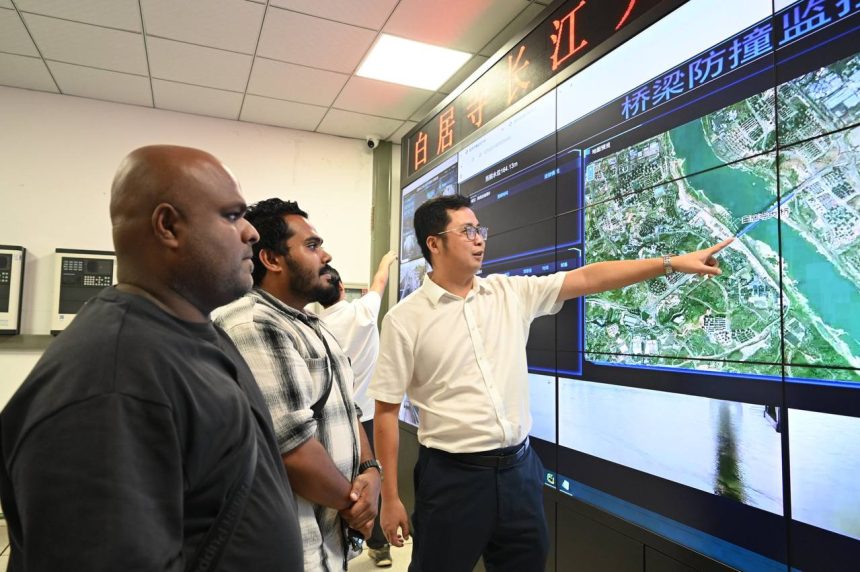
A team of Maldivian engineers undergoing specialised training in China has visited major bridge projects in Chongqing as part of efforts to build local expertise in maintaining critical infrastructure in the Maldives.
Chinese Ambassador to the Maldives Kong Xianhua said the engineers, who are from the Ministry of Infrastructure, Housing and Urban Development, have begun their training programme focusing on bridge maintenance and management.
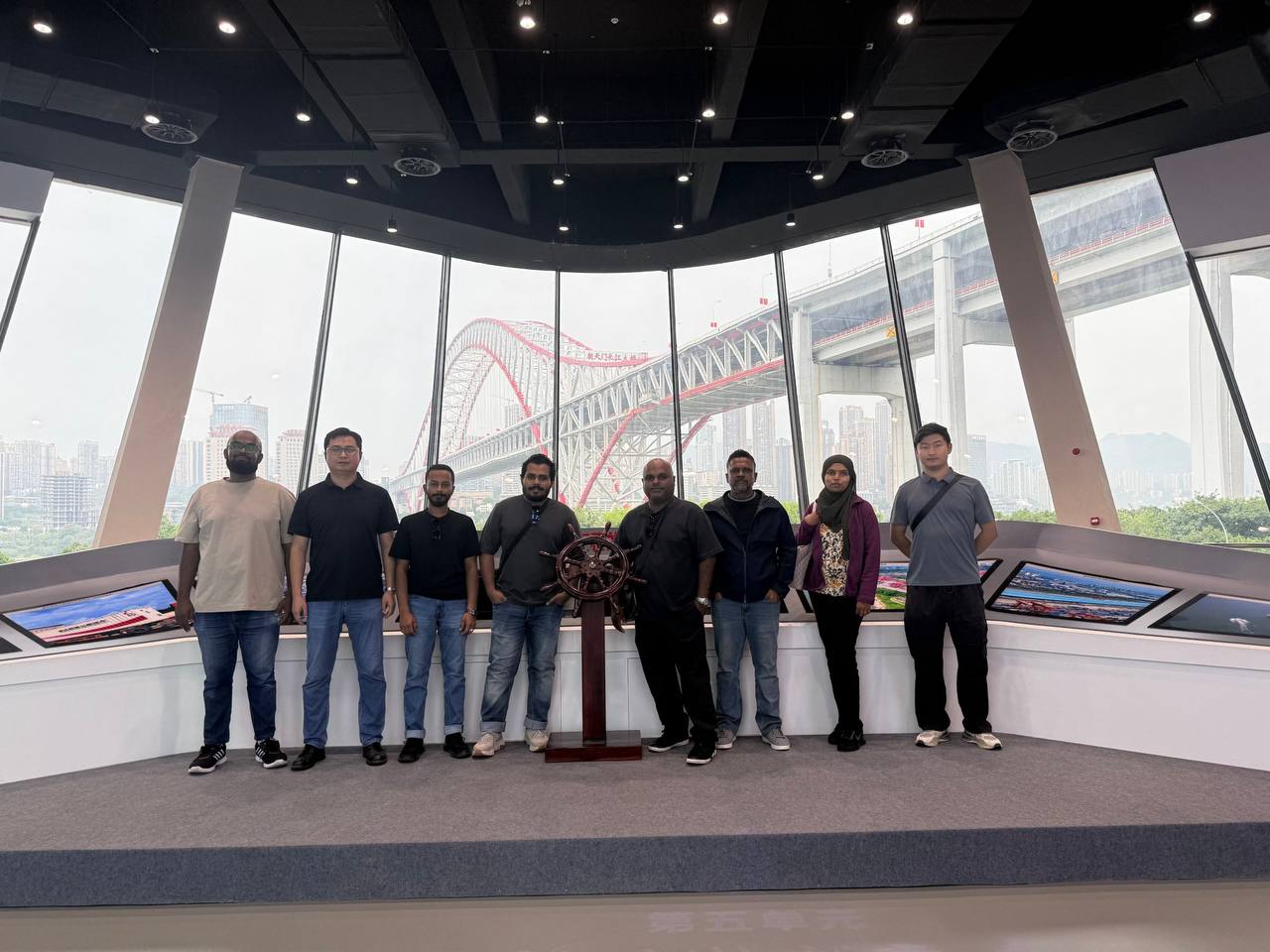
During the programme, the team visited the Baijusi Yangtze River Bridge and Chaotianmen Yangtze River Bridge in Chongqing, giving the engineers an opportunity to observe the operation and maintenance of major bridge infrastructure first-hand.

The Baijusi Yangtze River Bridge is a double-deck road and rail crossing, while the Chaotianmen Yangtze River Bridge is a major arch bridge spanning the Yangtze River.
According to Ambassador Kong, the visits provided the Maldivian team with practical exposure to China’s experience in bridge engineering, management and long-term maintenance.
The engineers also travelled on China’s high-speed railway network during the programme, allowing them to observe the country’s transport infrastructure and its operational systems.
Kong said China is prepared to continue sharing technical knowledge and experience with the Maldives, particularly in developing local expertise required for the safe and sustainable operation of major bridges.
The training programme is particularly relevant to the future maintenance of the Sinamalé Bridge, officially known as the China-Maldives Friendship Bridge.
The five-member technical delegation travelled to China for a programme running from September 15 to 26, aimed at developing local knowledge in bridge maintenance, structural inspections and repair procedures.
Before their departure, Kong met the engineers on September 13 and discussed the objectives of the programme.
During the meeting, members of the delegation said they hoped to acquire knowledge of modern bridge maintenance technologies that could be brought back to the Maldives and shared with other local professionals.
Kong said at the time that China’s objective was not simply to maintain infrastructure built with Chinese assistance, but to help Maldivians acquire the technical capabilities required to eventually undertake such work themselves.
Developing local bridge maintenance expertise has become increasingly important as the Maldives expands its road and bridge infrastructure.
The Sinamalé Bridge, which connects Malé with Hulhulé and provides the main road link towards Hulhumalé, opened in August 2018. The approximately 1.4-kilometre bridge was constructed with significant financial assistance from China and remains one of the largest infrastructure projects undertaken in the country.
China has continued to support the bridge after its completion.
Under an agreement signed in 2024, China is providing three years of maintenance and technical assistance for the bridge. The programme includes inspections, preventive maintenance, repairs, improvements to maintenance records and training Maldivian technicians to eventually take greater responsibility for maintaining the structure.
The current maintenance programme is being supported by CCCC Second Harbor Engineering Company, which has also been involved in training local personnel.
The importance of maintaining technical expertise around the bridge was highlighted earlier this month when two vessels struck the structure.
Chinese engineers subsequently inspected the bridge and found minor external damage but no damage to its main structure. Structural monitoring systems also indicated that the bridge remained stable following the incident.
China has previously said that building local technical capacity is an important component of its continued support for the bridge.
Following an inspection in May 2025, Kong called for more Maldivian engineers to be trained so that local professionals could eventually assume responsibility for bridge maintenance. Chinese officials said assessments at the time found the Sinamalé Bridge to be in good structural condition despite operating for years in the Maldives’ highly humid and corrosive marine environment.
The ongoing training in China represents another step towards that objective, exposing Maldivian engineers to the management of significantly larger and more complex bridge systems before applying the knowledge to infrastructure at home.